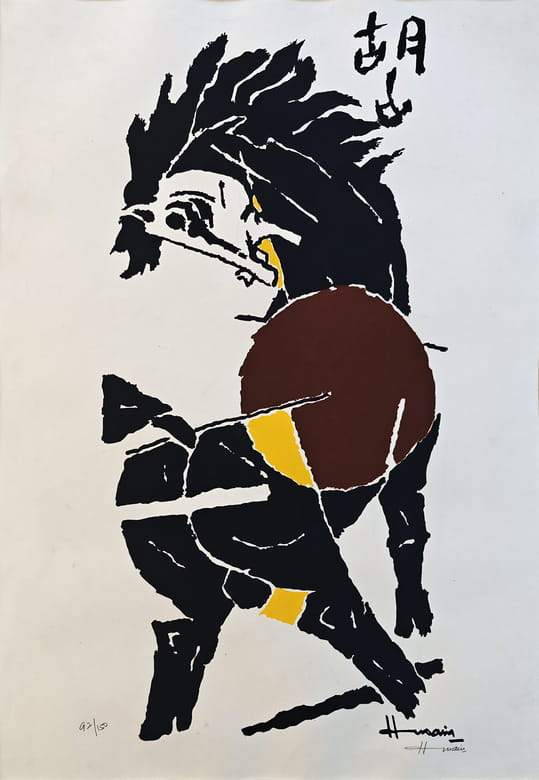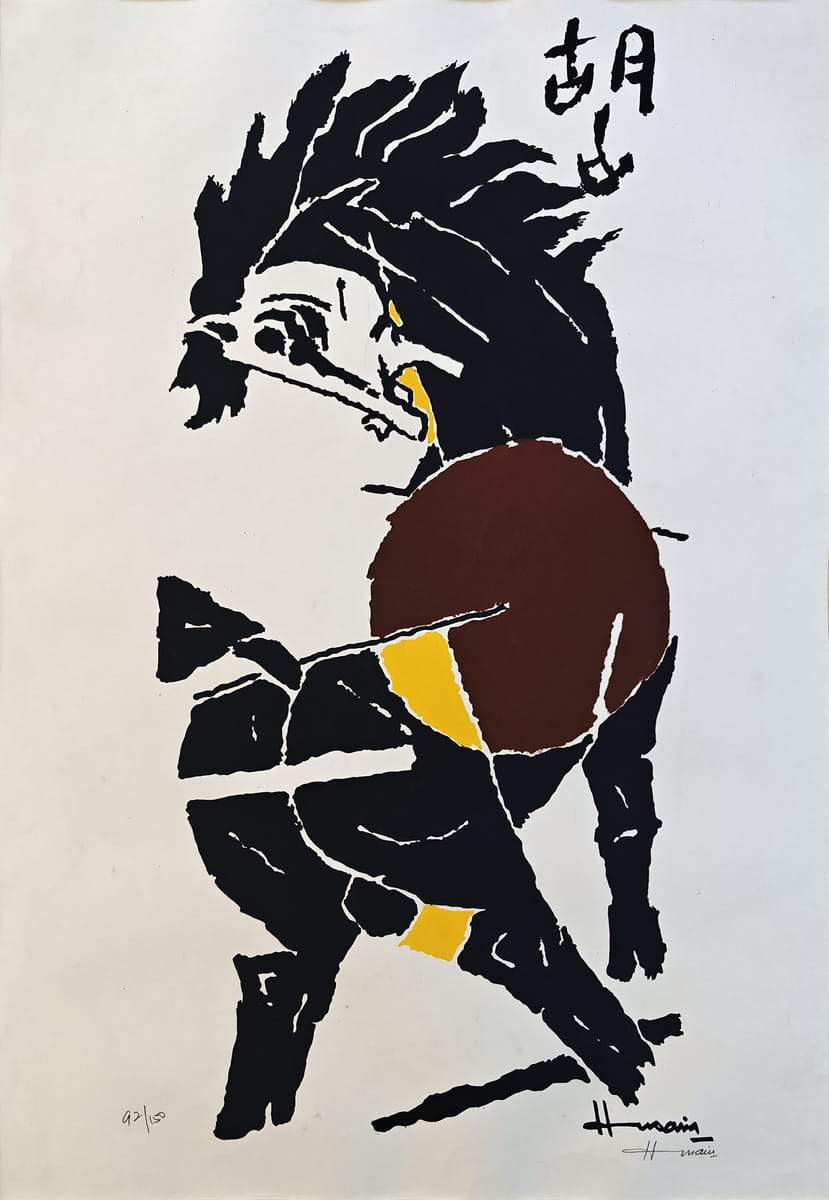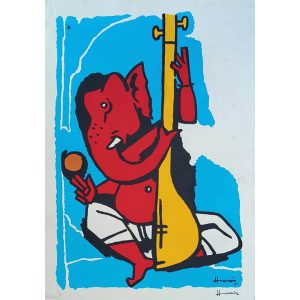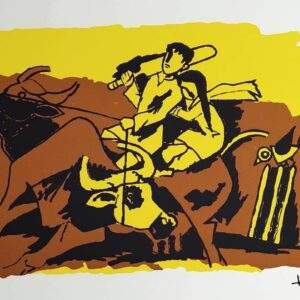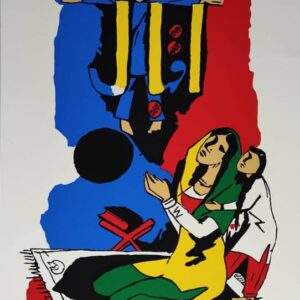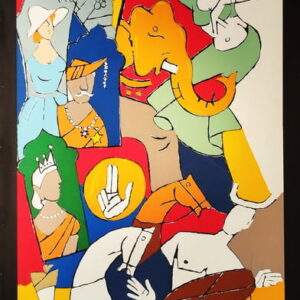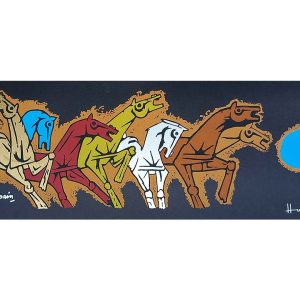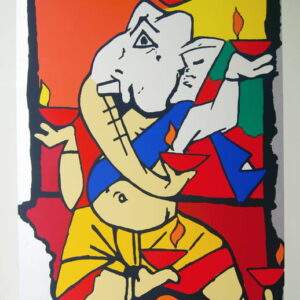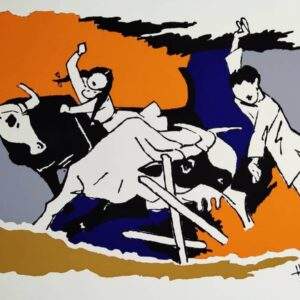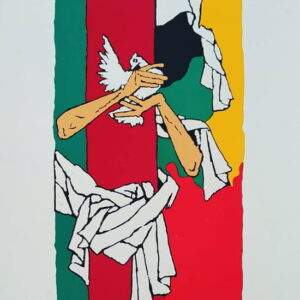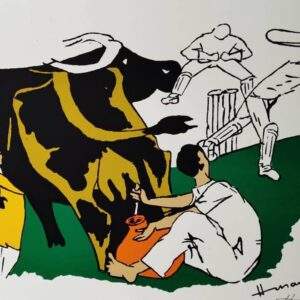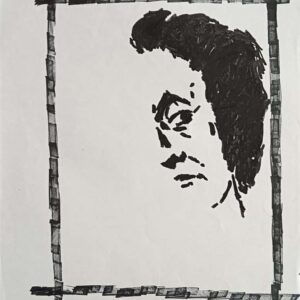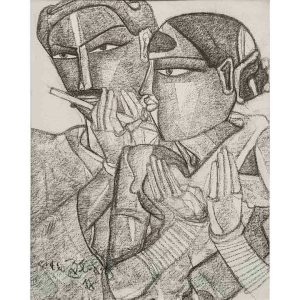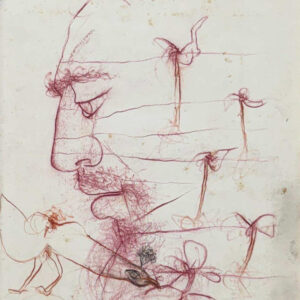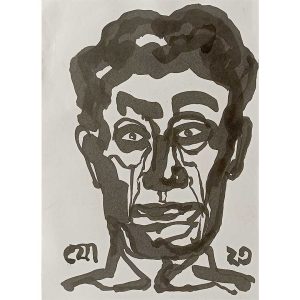
M.F. Husain | Untitled | Serigraph on Paper | Edition-92/150 | 39.5 x 27.5 inches
This striking serigraph by M. F. Husain captures the raw energy and expressive freedom that defined the artist’s visual language. Rendered in bold black forms with sharp, fragmented contours, the composition evokes movement, rhythm, and emotion through minimal yet powerful strokes. The figure-like form, paired with earthy brown and vibrant yellow accents, creates a dramatic contrast against the plain background, allowing the artwork’s intensity to take center stage.
Husain’s unmistakable style is visible in the spontaneous lines and semi-abstract treatment of the subject, where identity becomes secondary to expression and emotion. The artwork carries a tribal and primal essence, reflecting themes of strength, mythology, and human instinct often explored in his works. The balance between abstraction and figurative suggestion gives the piece a timeless modern appeal.
Printed as a limited-edition serigraph on paper, this work embodies both sophistication and collectability. Its monochromatic dominance combined with selective bursts of colour makes it ideal for contemporary interiors, art-focused spaces, or serious modern Indian art collections. The artwork stands not just as a visual statement, but as an emotional and cultural narrative shaped by one of India’s most celebrated modern masters.
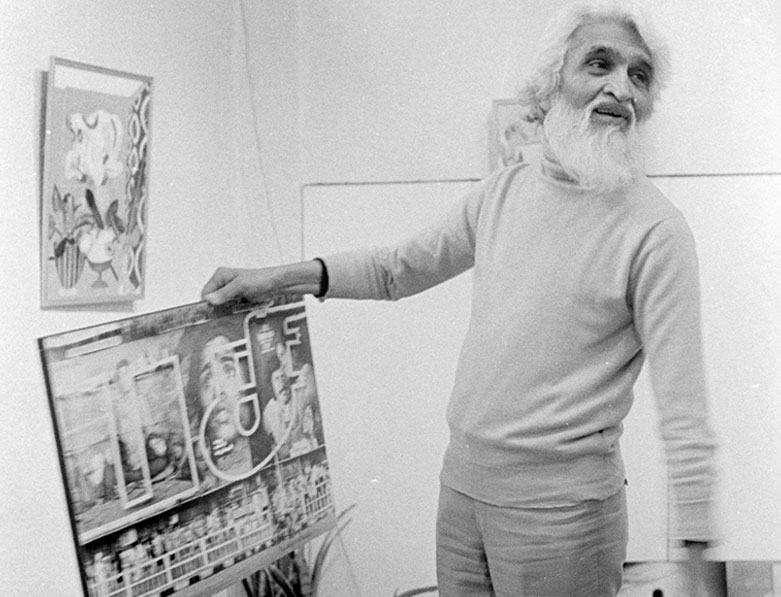 In the galaxy of modern masters, one name that is synonymous with twentieth century Indian Art, is M. F. Husain.
Born in Pandharpur, Maharashtra, on 17 September 1913, Husain came to Bombay in 1937 to become a painter, where he slept on footpaths and painted under streetlights. A self-taught artist, he began his career painting cinema posters and hoardings, and, in 1941, started making toys and furniture designs.
He imagined a secular language for modern Indian art that translated India’s ‘composite culture’ into a rich mosaic of colours. As a member of the Progressive Artists’ Group, launched in 1947, Husain heralded a new freedom for Indian art in the post-Independence decades. A peripatetic painter, Husain covered both geographical and conceptual territories, and transited at will between painting and poetry, assemblage and performance, installation and cinema. He experimented with text and images, and painted alongside musicians to translate music’s elusiveness into the accuracy of brushstroke. His first film, a short film titled Through the Eyes of a Painter, won the Golden Bear at the Berlin International Film Festival in 1967.

If you’d prefer the artwork to arrive ready to hang, please get in touch with us to arrange framing and shipping at applicable charges.
Please note: Customs duties and import taxes may apply at your destination in accordance with your country’s regulations. Refer to our International Shipment document for guidance and support.
| Medium | |
|---|---|
| Surface | |
| Height | |
| Width | |
| Style |