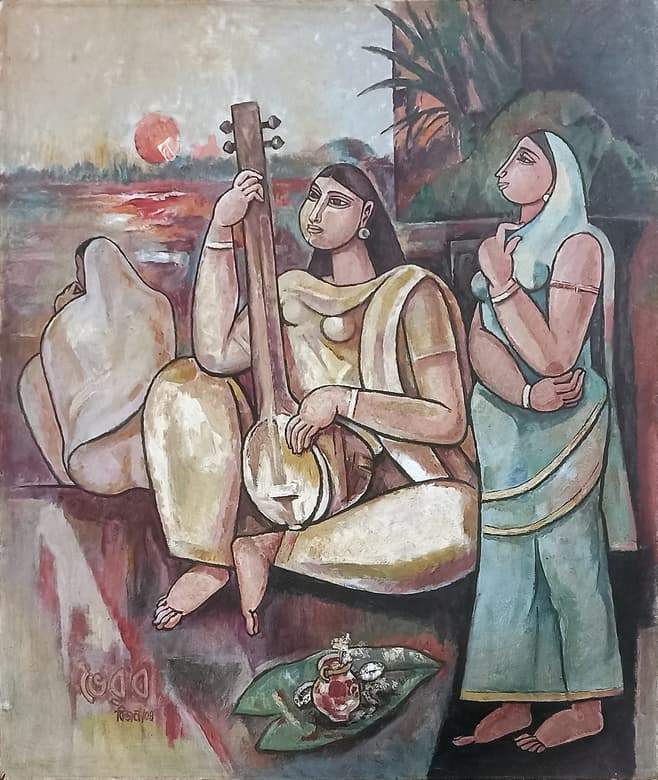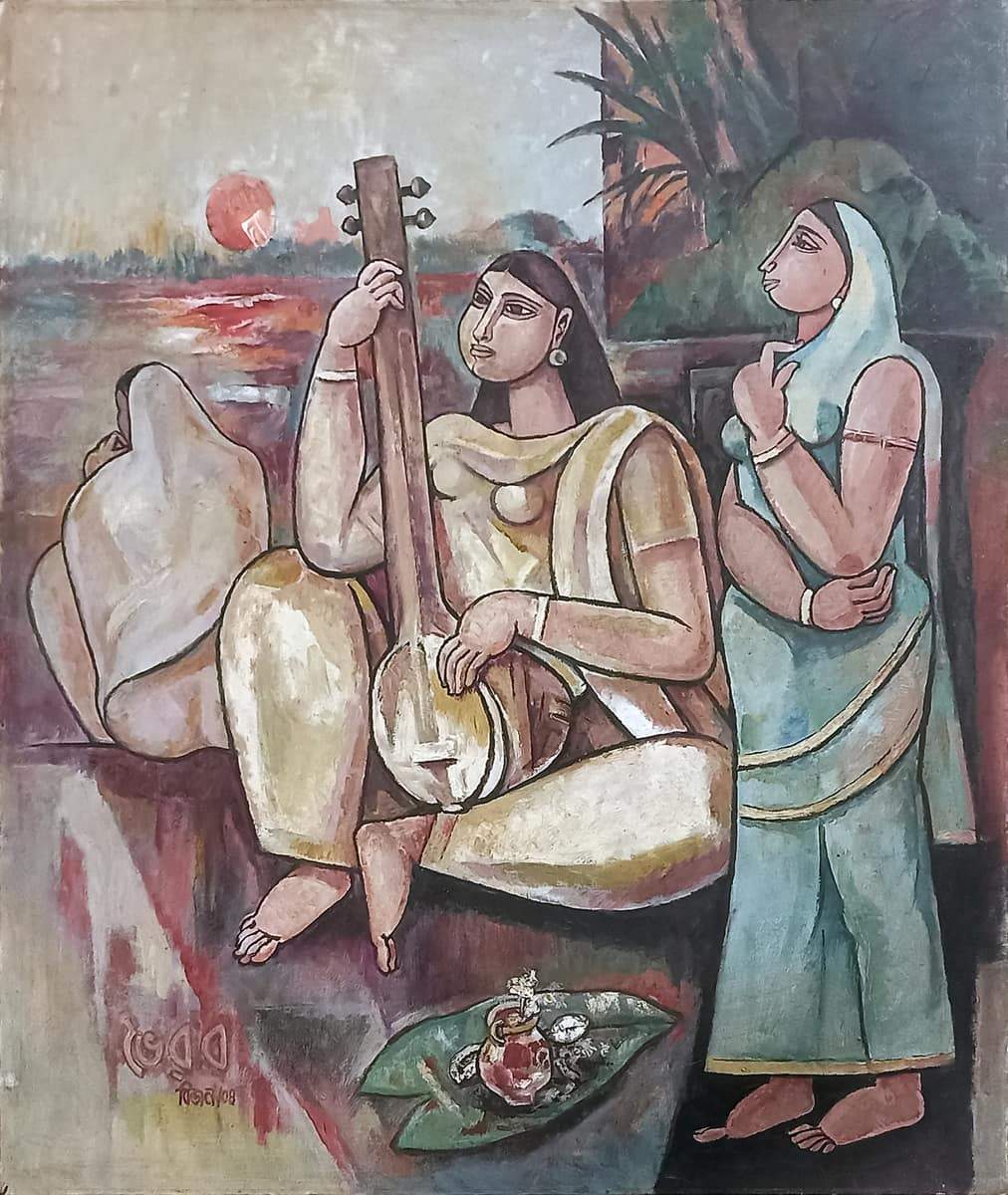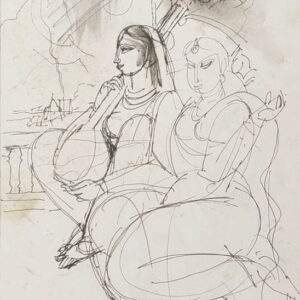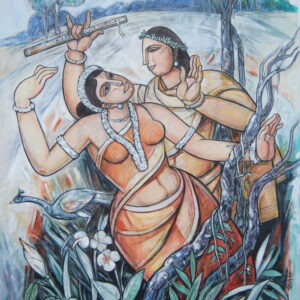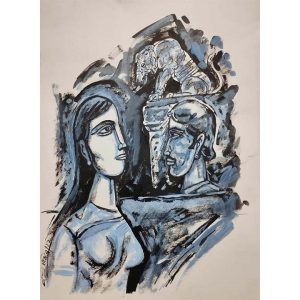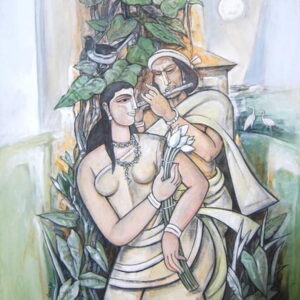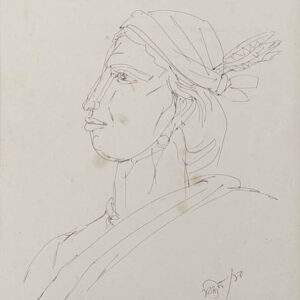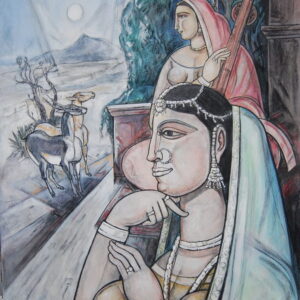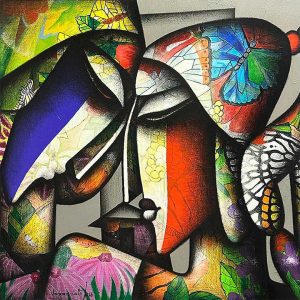
Bijan Choudhury | Bhairav | Oil on Canvas | 30 x 36 inches | 2004
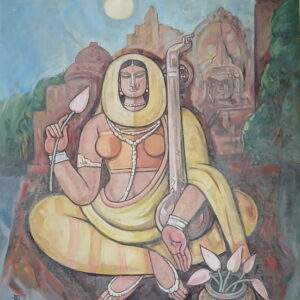
This evocative painting by Bijan Choudhury captures a quiet yet deeply expressive moment of rural Bengali life. Three women occupy the foreground, their stylised forms arranged around a traditional stringed instrument, creating a sense of companionship, music, and everyday storytelling. The central figure holds the instrument with a natural ease, while the women around her seem absorbed in the shared atmosphere.
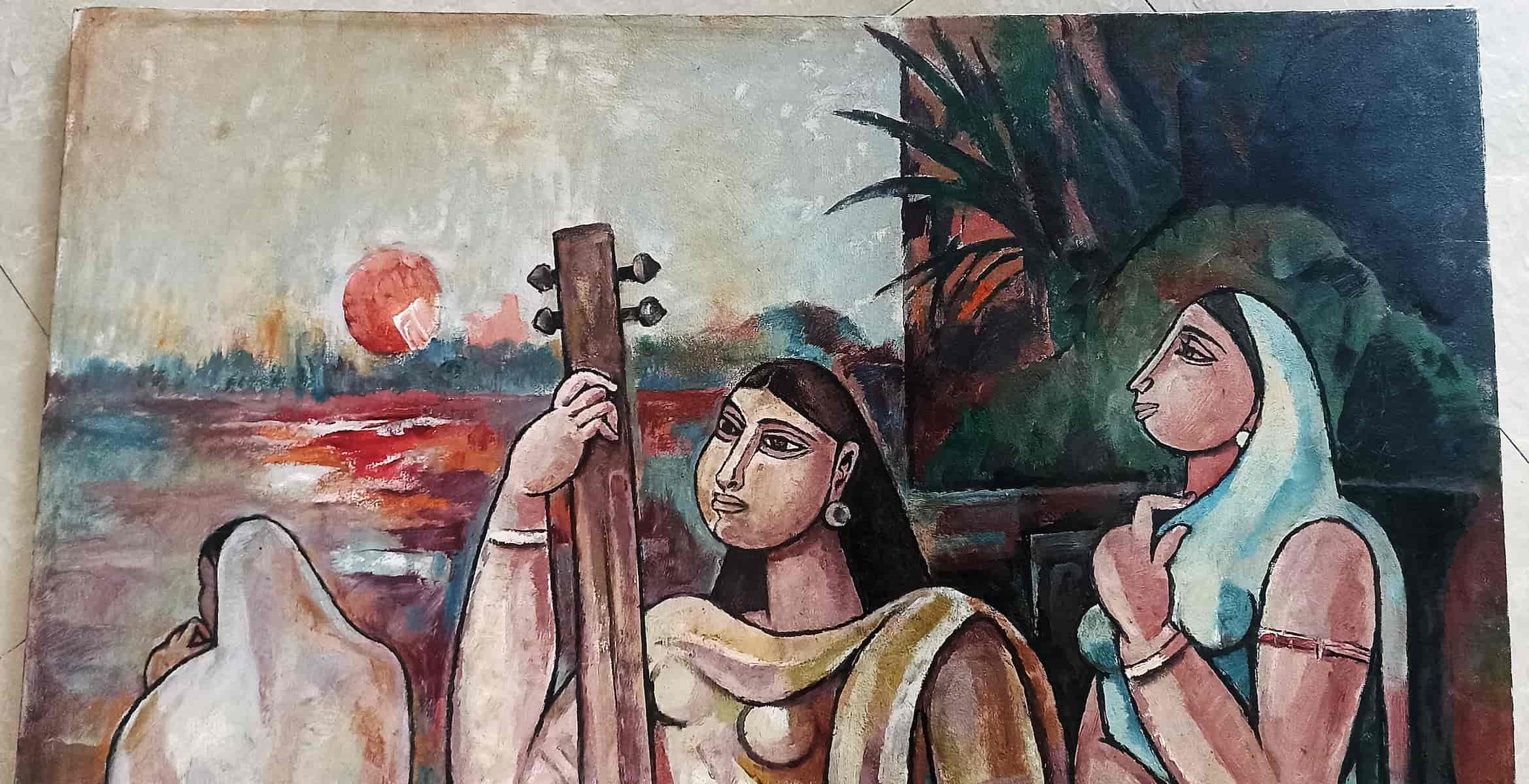
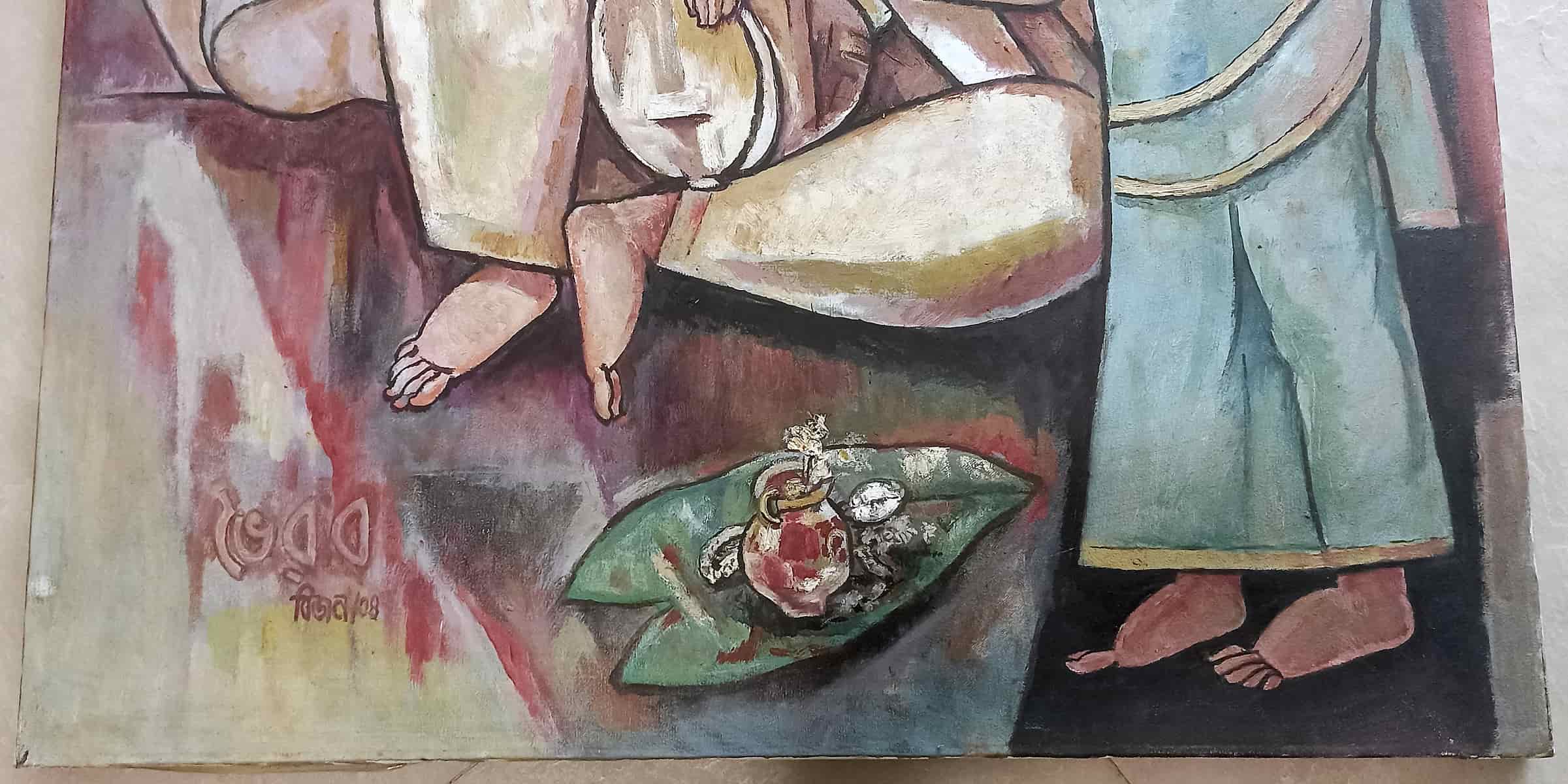
Choudhury’s characteristic use of strong, simplified forms and earthy colours gives the scene a timeless, almost folk-inspired quality. Soft creams, muted blues, browns and touches of red come together beautifully against the rural landscape, while the setting sun and trees in the background add warmth and depth. The small offering placed in the foreground brings an additional cultural and symbolic element to the composition.
Rather than simply depicting a village scene, the artwork celebrates the beauty of ordinary life — music, togetherness, tradition and quiet moments of human connection. The expressive faces and graceful postures make the figures feel both stylised and remarkably alive, giving the painting a warm, intimate character.
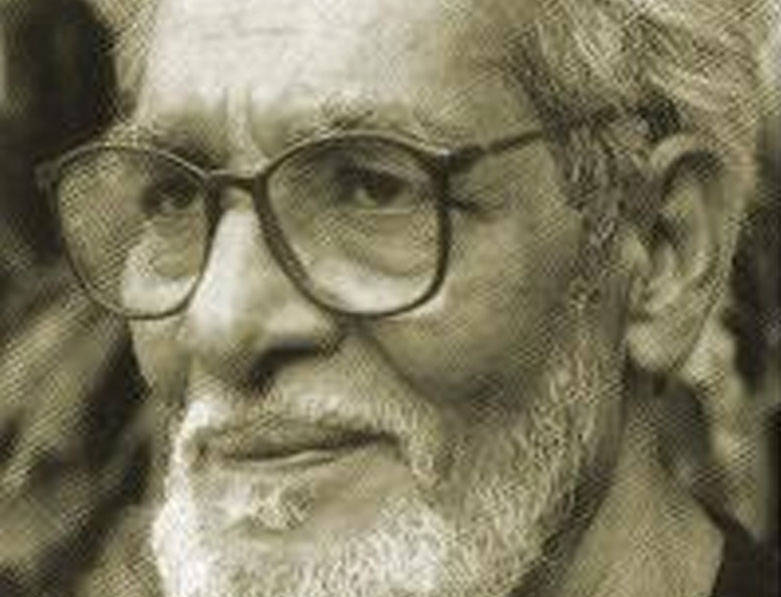 Artist Bijan Choudhury was born in Faridpur in 1931. He was one of the early practitioners of contemporary art in Bengal. Every serious workshop would find him involved in an exchange of thoughts and idioms of visual and literary expressions.Born to journalist Kunjabehari Chowdhury, Bijan Chowdhury was raised in an atmosphere steeped in music, painting and drama. Bijan Choudhury has worked on the imagery of Bengali poetry as it has evolved since its earliest days to the present, covering almost more than four centuries of poetical development.
His paintings have narrative elements but are in no way illustrative. He is here both as a composer and interpreter. His archetypal imagery and symbolism are not explicit as in the recent Indian variety of Surrealism and fantastic art. He has always avoided the sensational and the fearful aspects of art. He has searched for significant visual forms that have behind them the range and scope of Human Art since the earliest cave dwelling days.
Since his early days at Kolkata’s Govt College of Art and Craft he was deeply involved in Marxist politics. This led to his being expelled before completing his diploma but strengthened his bond with Dhaka as it prompted him to graduate from their Govt Institute of Arts. And till his last breath he considered Bangladesh to be his own.
Artist Bijan Chowdhury passed away in 2012.
Education
1945-49: GCAC, Kolkata; 1953: Grad., Govt. Institute of Arts, Dhaka.
Exhibitions
1959 Group show, Society of Contemporary Artists, Calcutta.
1960 Group show, Society of Contemporary Artists, Calcutta.
1960 Bangla Sanskriti Sammelan, Calcutta and Bombay.
1962 Solo show at Arts and Prints Gallery, Calcutta.
1963 Solo show at Arts and Prints Gallery, Calcutta.
1963 Solo Exhibition at Patna.
1964 Eight Painters from Calcutta, AIFACS Gallery, New Delhi.
1964 Calcutta Painters group show, Calcutta.
1965 Calcutta Painters group show, Calcutta.
1966 Show in honour of Giacometti, Industry House, Calcutta.
1968 Exhibition with Paritosh Sen, Pravas Sen, Sarbari Roy Chowdhury, Mahim Rudra, Calcutta.
1969 West Bengal Artists, sponsored by Srinantwu, Bombay.
1974 Exhibition at Birla Academy of Art & Culture, Calcutta.
1974 Calcutta Painters group show, Birla Academy of Art & Culture, Calcutta.
1975 Calcutta Painters group show, Sridharani Art Gallery, New Delhi.
1975 Participated in the Third Triennale, New Delhi.
1977 Retrospective, Allai
Awards
1963 Academy of Fine Arts Award, Calcutta.
1978 Rabindra Bharati Award, Calcutta.
1978 Documentary coloured film entitled `Bijan`, made by Film Australia, Film Division of Govt. of Australia.
1995 `Abanindra Puroshkar`, Govt. of West Bengal, Calcutta.
1996 : He also received William Carey Award.
2004: Doctor of Literature, RBU

If you’d prefer the artwork to arrive ready to hang, please get in touch with us to arrange framing and shipping at applicable charges.
Please note: Customs duties and import taxes may apply at your destination in accordance with your country’s regulations. Refer to our International Shipment document for guidance and support.
| Medium | |
|---|---|
| Height | |
| Width | |
| Surface | |
| Style |