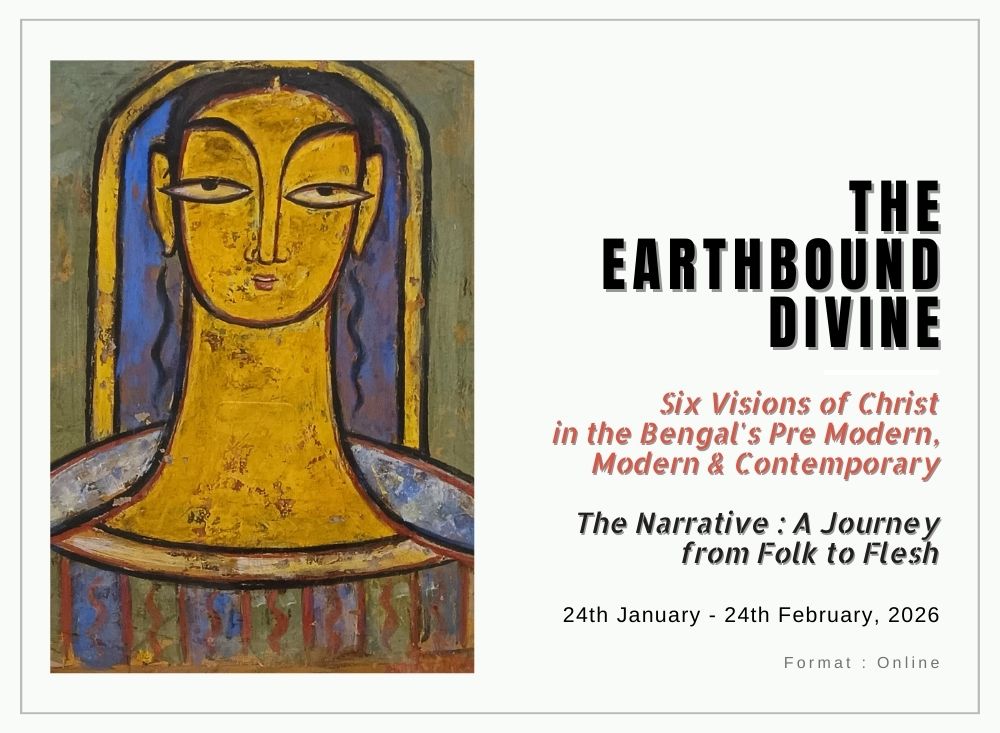
The Earthbound Divine
Six Visions of Christ in the Bengal’s Pre Modern, Modern & Contemporary
The Narrative: A Journey from Folk to Flesh
24th January – 24th February 2026
Artists : Jamini Roy , Somenath Hore , Shyamal Dutta Ray , Wasim Kapoor, Suhas Roy , Suman Roy
Divine Visions: Christianity in Indian Modern Art
India’s artistic heritage is a tapestry woven with threads of diverse faiths, philosophies, and cultural expressions. Among these, Christianity—though a minority religion—has left a profound and evocative imprint on Indian modern art, especially through artists who found spiritual and aesthetic resonance in its themes. This exhibition, opening on December 25th, celebrates the birth of Christ and the spirit of Christmas by showcasing works that reinterpret Christian iconography through the lens of Indian modernism.
Christianity in Indian Art: A Cross-Cultural Dialogue
Christianity arrived in India as early as the first century CE, but its visual representation in Indian art gained prominence during the colonial period and flourished in the post-independence modernist era.
Artists exposed to Western religious art began to explore Christian themes — not as foreign imports, but as universal symbols of suffering, compassion, and redemption. The image of Christ on the cross, the Madonna and Child, and the Last Supper became metaphors for human vulnerability, spiritual longing, and communal unity.
Christianity in Indian art transcends the record of a minority faith to become a profound aesthetic dialogue between the “Universal Man” and the “Indian Soul,” a narrative reimagined by four titans of Bengal’s art history who stripped away European Baroque grandeur to reveal a more urgent, localized, and human divinity.
The journey begins with Jamini Roy, the “Alpha” of this movement, who rejected Western oil traditions for the red clay of Bankura and the Patua scroll style; his Christ, characterized by the almond eyes of a Santhal tribesman and the stoic posture of a village elder, proved that the Messiah could belong to Indian soil through a palette of soot-blacks and vermillion-reds.
In visceral contrast, Wasim Kapoor utilized a dark, monochromatic empathy to transform Christ into the ultimate symbol of the oppressed, where jagged lines and deep shadows mirror the struggles of Kolkata’s urban marginalized, casting the “Crown of Thorns” as a contemporary accessory for those fighting for dignity.
Shyamal Dutta Roy, the master of the “broken watercolor,” is represented in this exhibition with a pensive, Christ crucified on the cross, placing Christ amidst the crumbling, moss-covered architecture of colonial Bengal to comment on the decay of modern values and the heavy burden of the intellectual in a shifting society.
Finally, Suman Roy brings these traditions into the modern meditative realm, focusing on the psychological depth of the “Heads of Christ” through a cinematic interplay of light and shadow that presents Jesus as a weary, relatable, and quiet companion in a chaotic world.
As this catalogue is released right post the recently concluded season of Advent, it serves not as a mere collection of religious icons, but as a testament to plurality—a mirror held up to India where the Christmas story becomes a narrative of identity, resilience, introspection, and soulfulness, celebrating a Christ who does not stand above us, but walks beside us in the dusty lanes of our shared history.