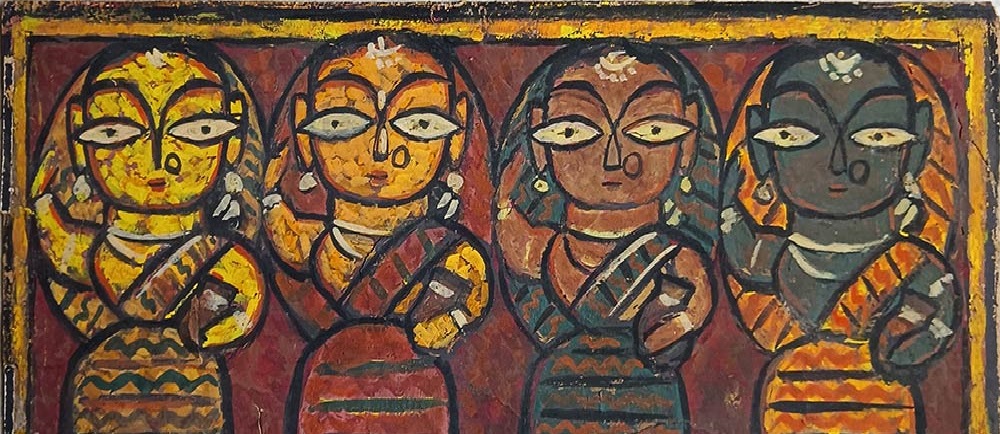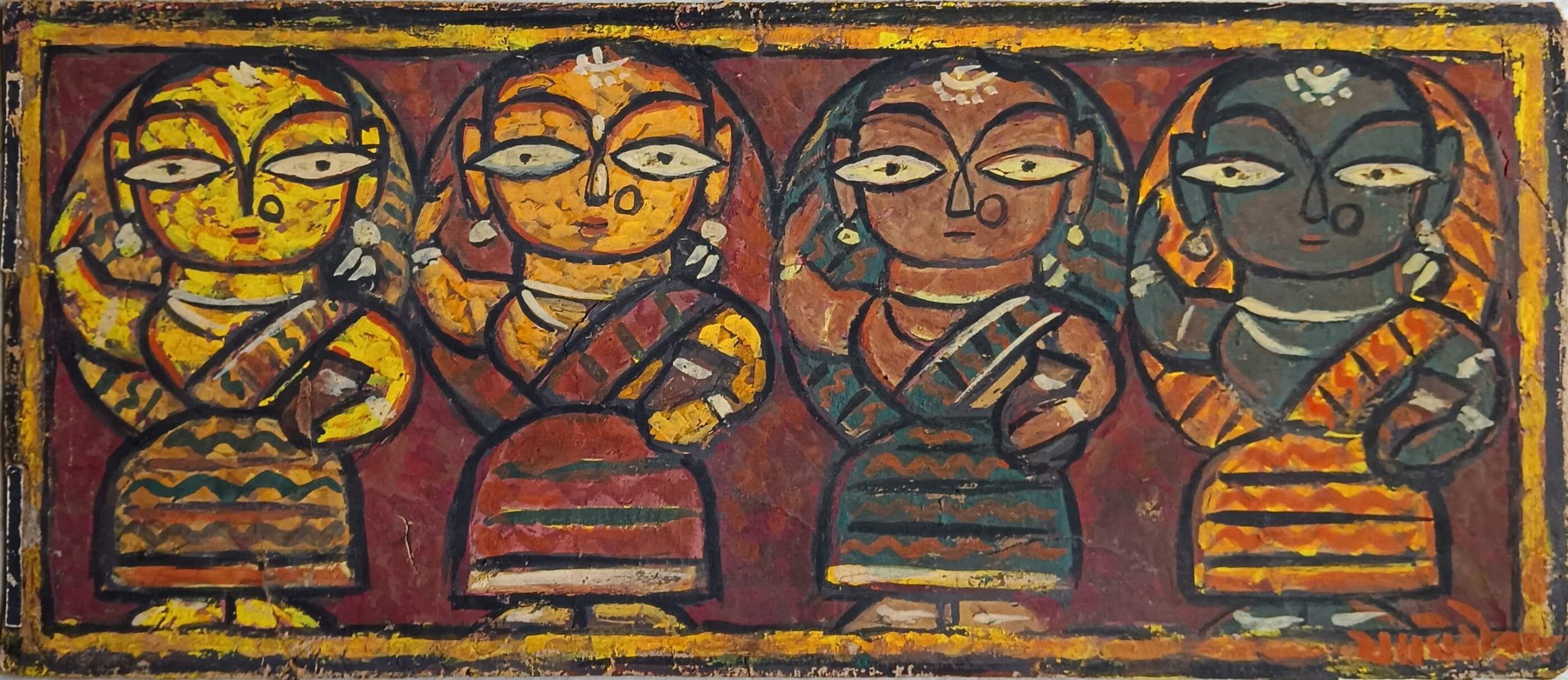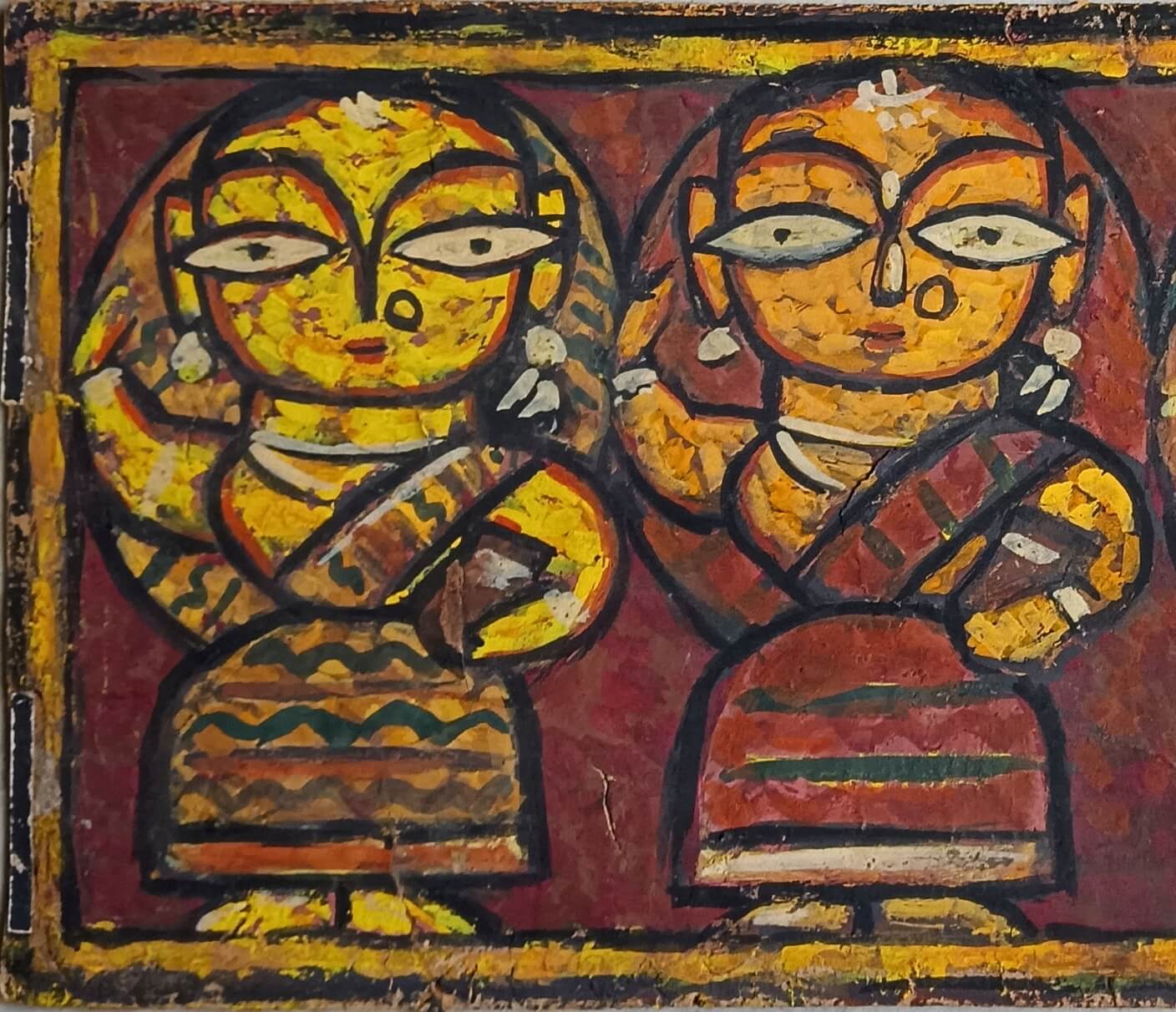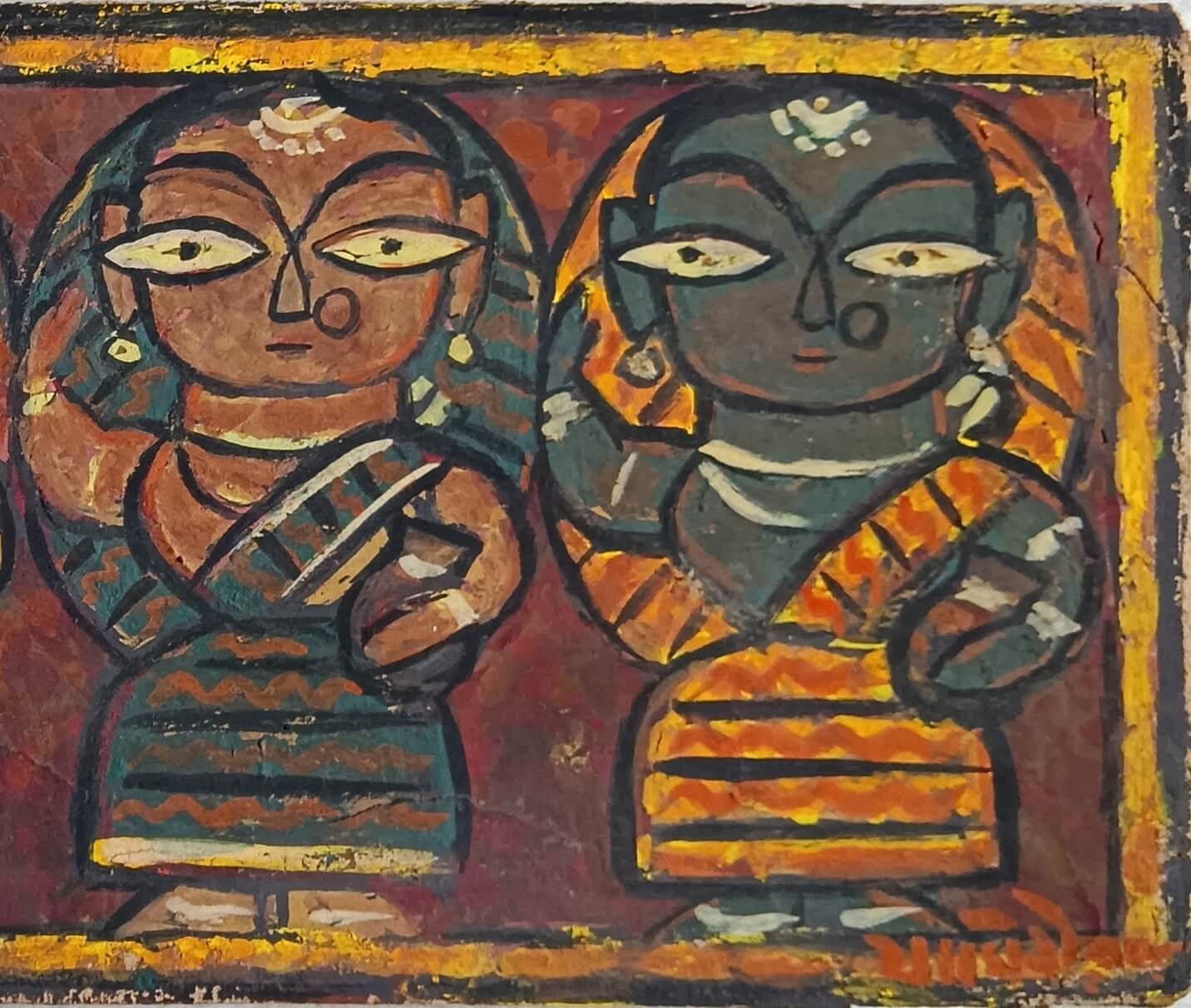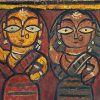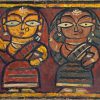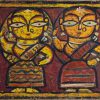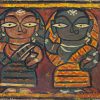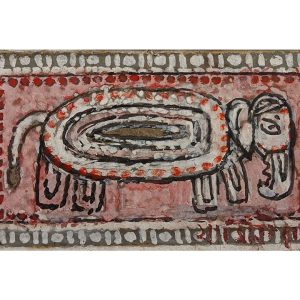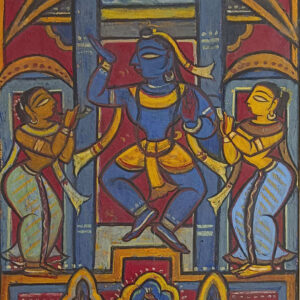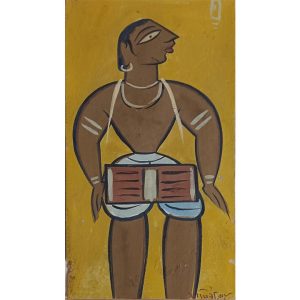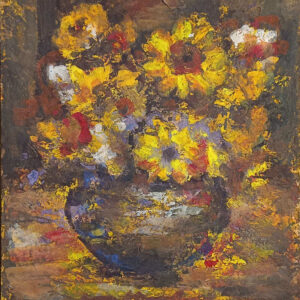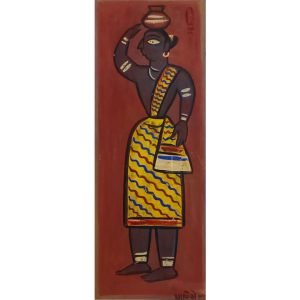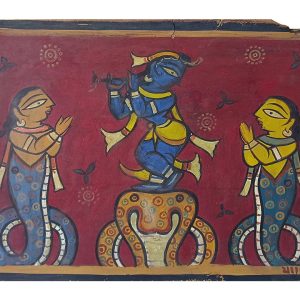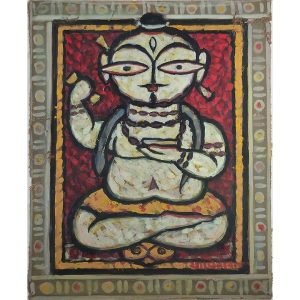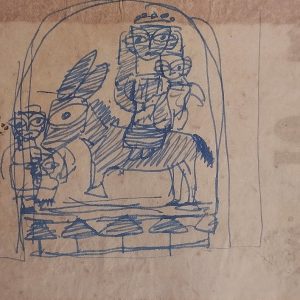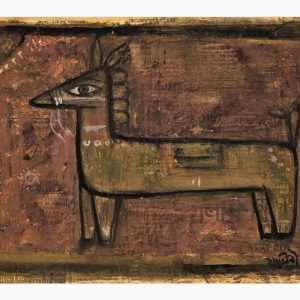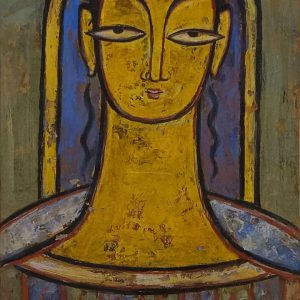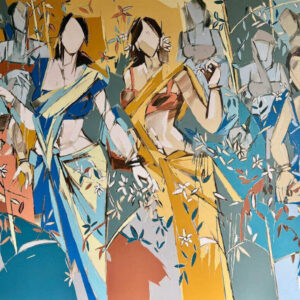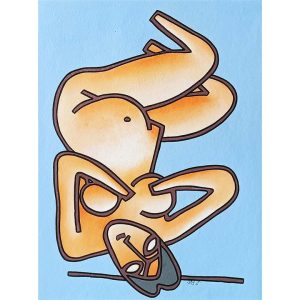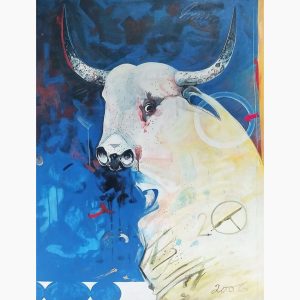
Jamini Roy | Untitled | Tempera on Board | 6.5 x 16.5 inches
Jamini Roy’s painting of four stylized village women—defined by bold contours, earthy tempera, and rhythmic symmetry—epitomizes his transformation of Indian folk idioms into modernist form. Drawing from Kalighat pat and patachitra, Roy rejected colonial realism to create archetypal figures that embody grace, labor, and collective identity. His flattened space, serial repetition, and decorative borders align with global modernists like Matisse and Modigliani, yet remain rooted in indigenous craft. This work, part of a broader corpus of ritualized compositions, marks a pivotal shift in Indian art—from mimicry to native modernity.
This painting belongs to a broader corpus of Roy’s multi-figure compositions—women bearing pots, harvest scenes, Santhal dancers—that articulate a visual grammar of repetition, ritual, and serenity. It is not narrative but meditative, inviting the viewer into a world where line and color become carriers of cultural memory. In the context of Indian art history, Roy’s work marks a decisive shift: from colonial mimicry to indigenous modernity, from salon painting to studio craft, from elite portraiture to communal archetype.
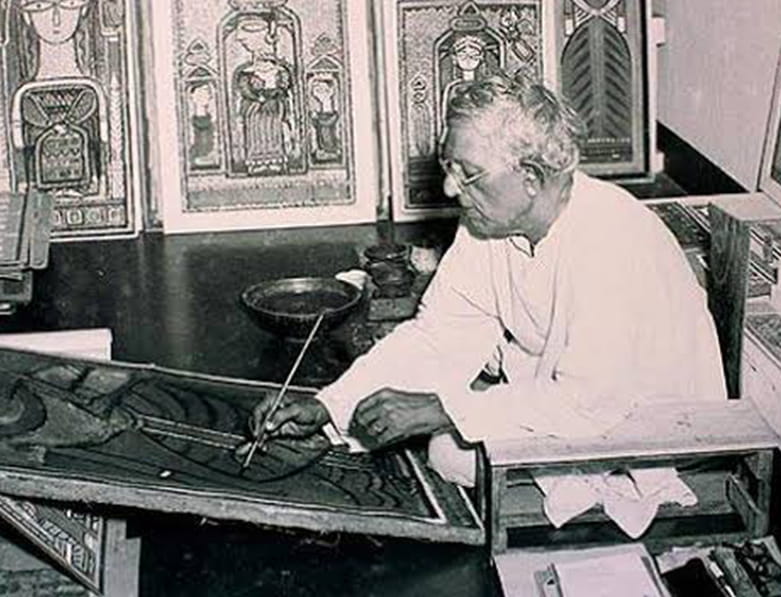 One of india’s most loved artists, Jamini Roy is remembered for forging a unique indian aesthetic for modern art by bringing together elements of traditional bengali folk art and kalighat patachitras, rendered in clean lines and earthy colours.
Born on 11 April 1887 in a landowning family in Bankura district of Bengal, Roy trained in European academic-realist painting at the Government College of Arts and Crafts, Calcutta, and began his career painting landscapes and portraits.
Soon, moving away from these, he started experimenting with a more indigenous visual vocabulary. Level surfaces, flattening of design in depth, and the use of dissonant primary colours were aspects of folk painting that Roy incorporated in his work. Also, he took up the volumetric forms of the Kalighat patachitras. However, unlike the spontaneous brushwork of the traditional patuas, Roy’s lines were more restrained and precisely delineated.
Roy would paint several versions of a subject, breaking and reforming the theme over months. Turning his family into a production unit, he tried to emulate a craft-guild mode of artistic production. He painted on a wide range of themes—common people, mythological tales, Christian iconography, as well as visual characteristics of home-sewn Bengal quilts and Byzantine icons.
Roy was awarded the Viceroy’s gold medal in 1935, the Padma Bhushan in 1955, and elected a fellow of the Lalit Kala Akademi in 1956. Declared a National Treasure artist in 1976, his works cannot be exported. He passed away on 24 April 1972.

If you’d prefer the artwork to arrive ready to hang, please get in touch with us to arrange framing and shipping at applicable charges.
Please note: Customs duties and import taxes may apply at your destination in accordance with your country’s regulations. Refer to our International Shipment document for guidance and support.
| Medium | |
|---|---|
| Height | |
| Width | |
| Surface | |
| Style |