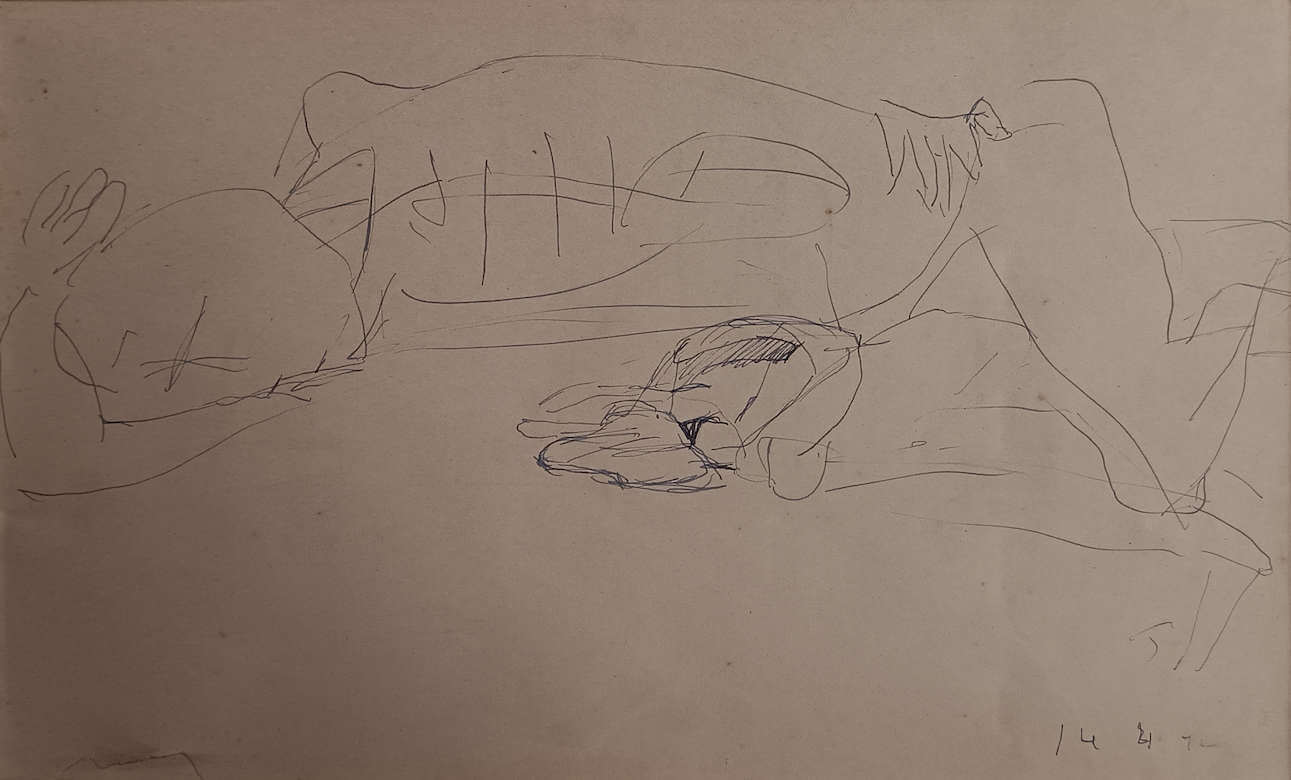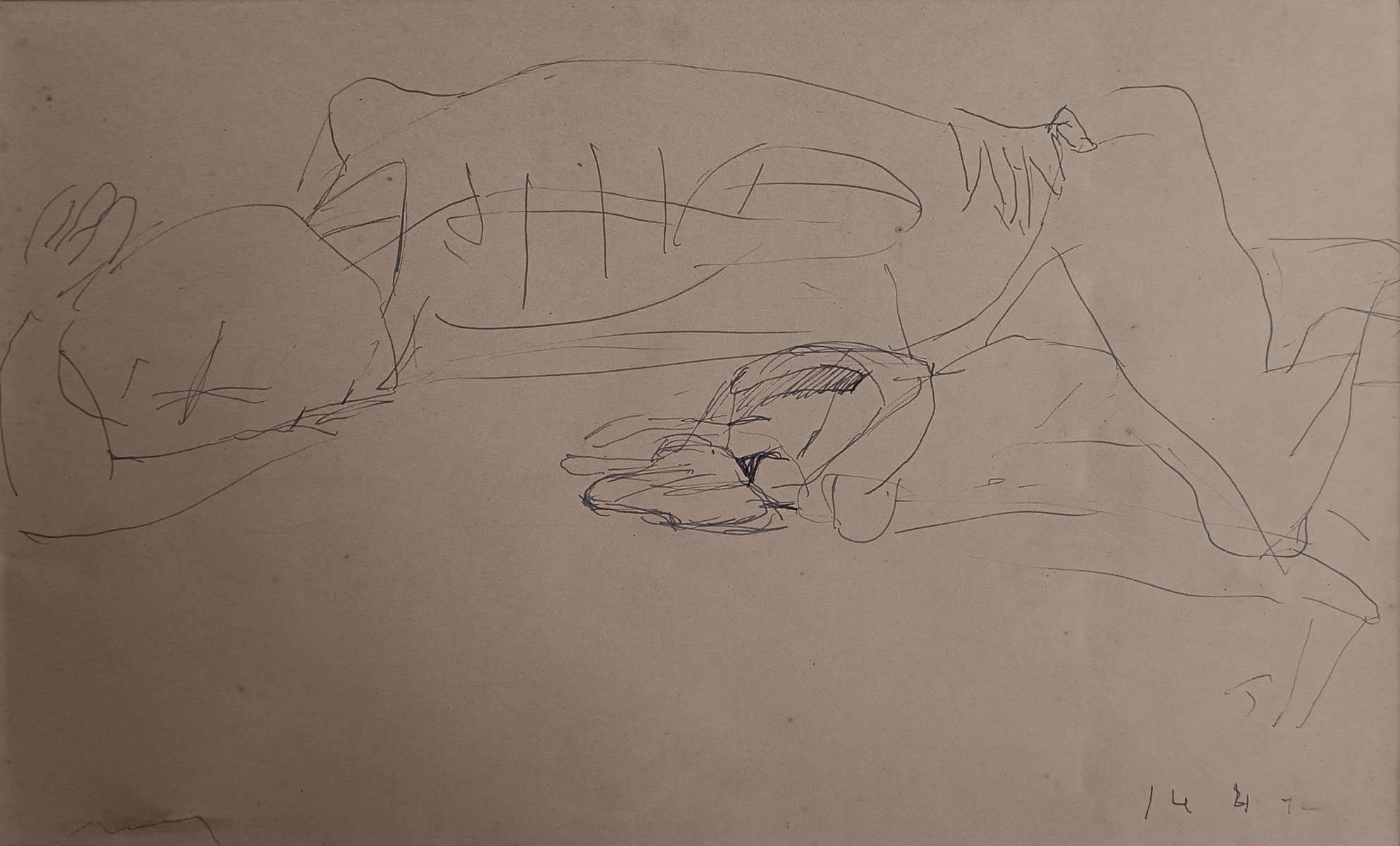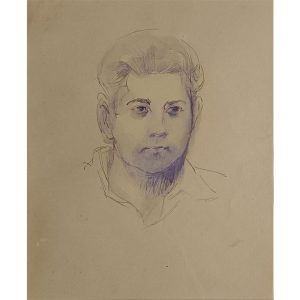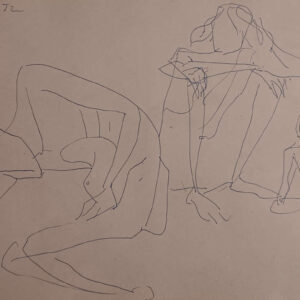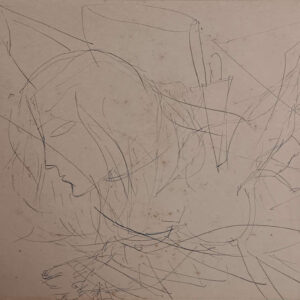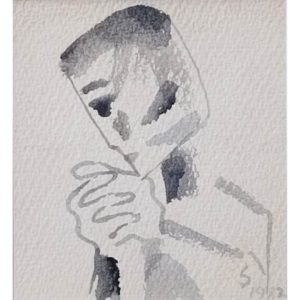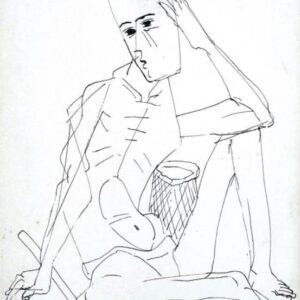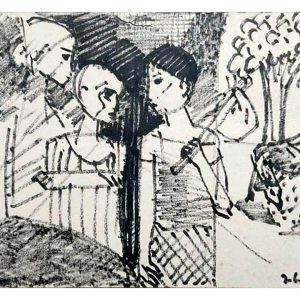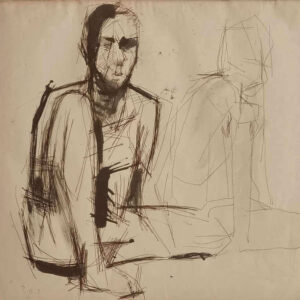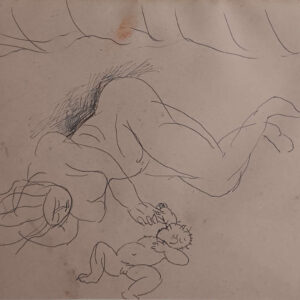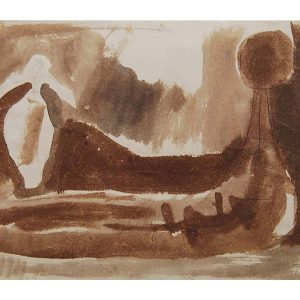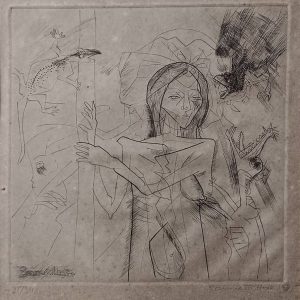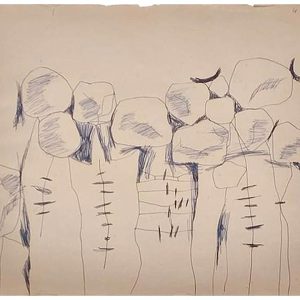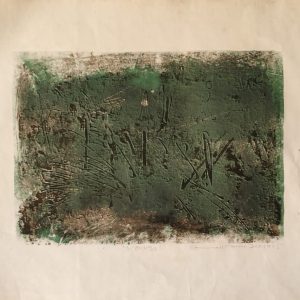
Somnath Hore | Untitled | Pen & Ink on Paper | 7 x 10.8 inches | 1972
This untitled pen-and-ink drawing by Somnath Hore is a deeply restrained yet powerful exploration of the human body in a state of collapse and quiet suffering. The composition is stretched horizontally, with a reclining figure reduced to a few continuous, searching lines that suggest a body at rest—or perhaps overcome by exhaustion. Hore’s linear economy is striking: the head, torso, and limbs are barely articulated, yet their placement conveys weight, vulnerability, and a sense of physical and emotional depletion. Fragmented markings along the torso hint at bone or internal structure, reinforcing themes of fragility and exposure. A loosely sketched hand near the center, darkened with denser strokes, becomes a subtle focal point, intensifying the feeling of tension and pain. Set against an empty ground, the figure appears suspended in silence, allowing the viewer to confront the raw condition of the human form without distraction. True to Hore’s humanist vision, the drawing transforms minimal means into a profound statement on endurance, loss, and the quiet dignity of suffering.
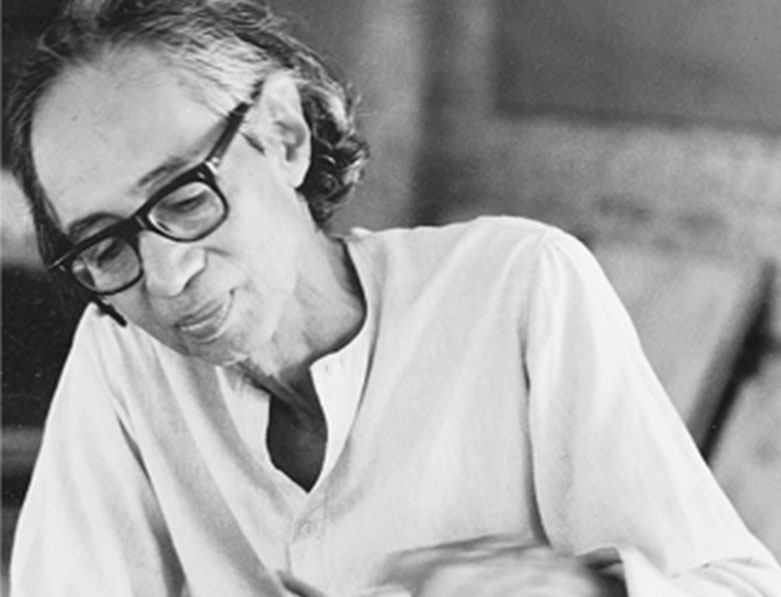
Somnath hore was the quintessential bengal artist deeply affected by the cataclysms that changed its history, such as the 1943 famine. a man-made crisis resulting in the death of two-three million people and the 1946 tebhaga peasant uprising.
A multifaceted artist who spent a lifetime exploring human suffering through his sketches, prints and sculptures, Somnath Hore was born in Chittagong in present-day Bangladesh in 1921.
Studying briefly at Government School of Art, Calcutta, in the mid-1940s, Hore trained under Zainul Abedin, and, later, under printmaker Saifuddin Ahmed. A participatory practice with fellow artists like Chittaprosad led to his intellectual growth. Hore’s early sketches were published in Janayuddha and People’s War, publications of the Communist Party; like many young men in the 1940s, Hore too joined the political party though he drifted away from it later.
Hore chose a distinctly formal, Western style of artmaking, distinguished by its strong linear quality, and guided by humanist concerns that foregrounded the indigent grappling with issues of survival. Distilled into iconic heads and emaciated bodies, his act of recovering the erased re-inscribed them into public memory. The anguished human form was reflected in Hore’s figuration through bold, minimal strokes enhanced by rough surfaces, slits and holes.
Over a thirty-year teaching career, Hore set up the printmaking department of Delhi Polytechnic in 1958. He joined Kala Bhavana, Santiniketan, as head of its printmaking department in 1968, where his own practice received a boost under the guidance of Ramkinkar Baij and Benodebehari Mukherjee.

If you’d prefer the artwork to arrive ready to hang, please get in touch with us to arrange framing and shipping at applicable charges.
Please note: Customs duties and import taxes may apply at your destination in accordance with your country’s regulations. Refer to our International Shipment document for guidance and support.
| Medium | |
|---|---|
| Surface | |
| Height | |
| Width | |
| Style |