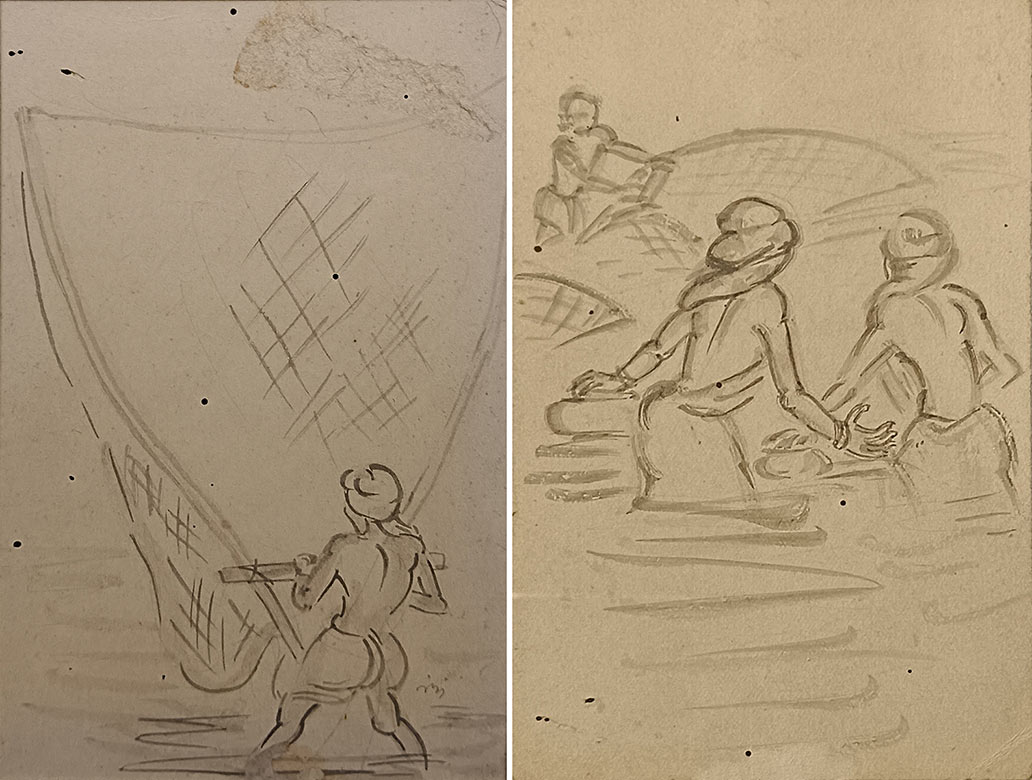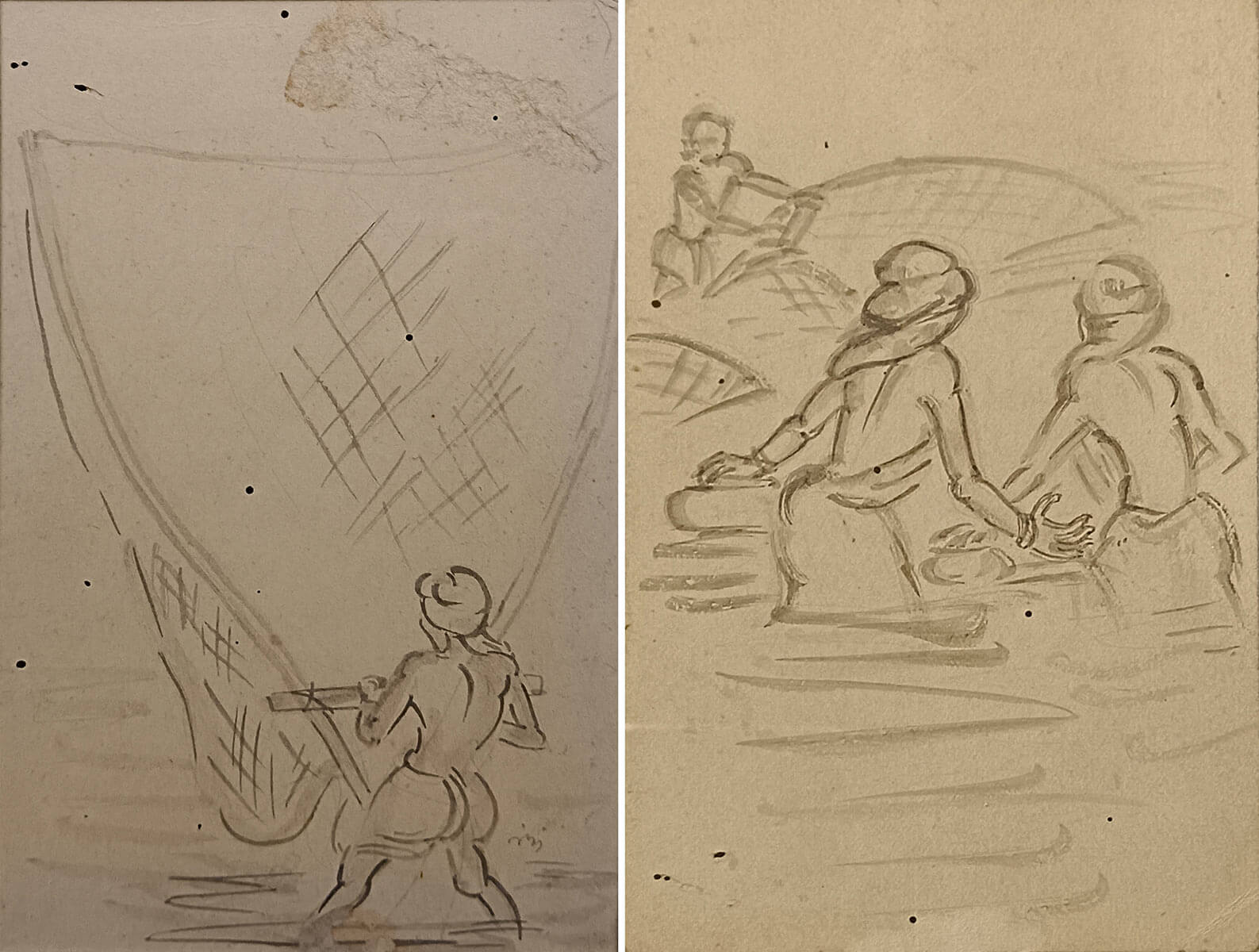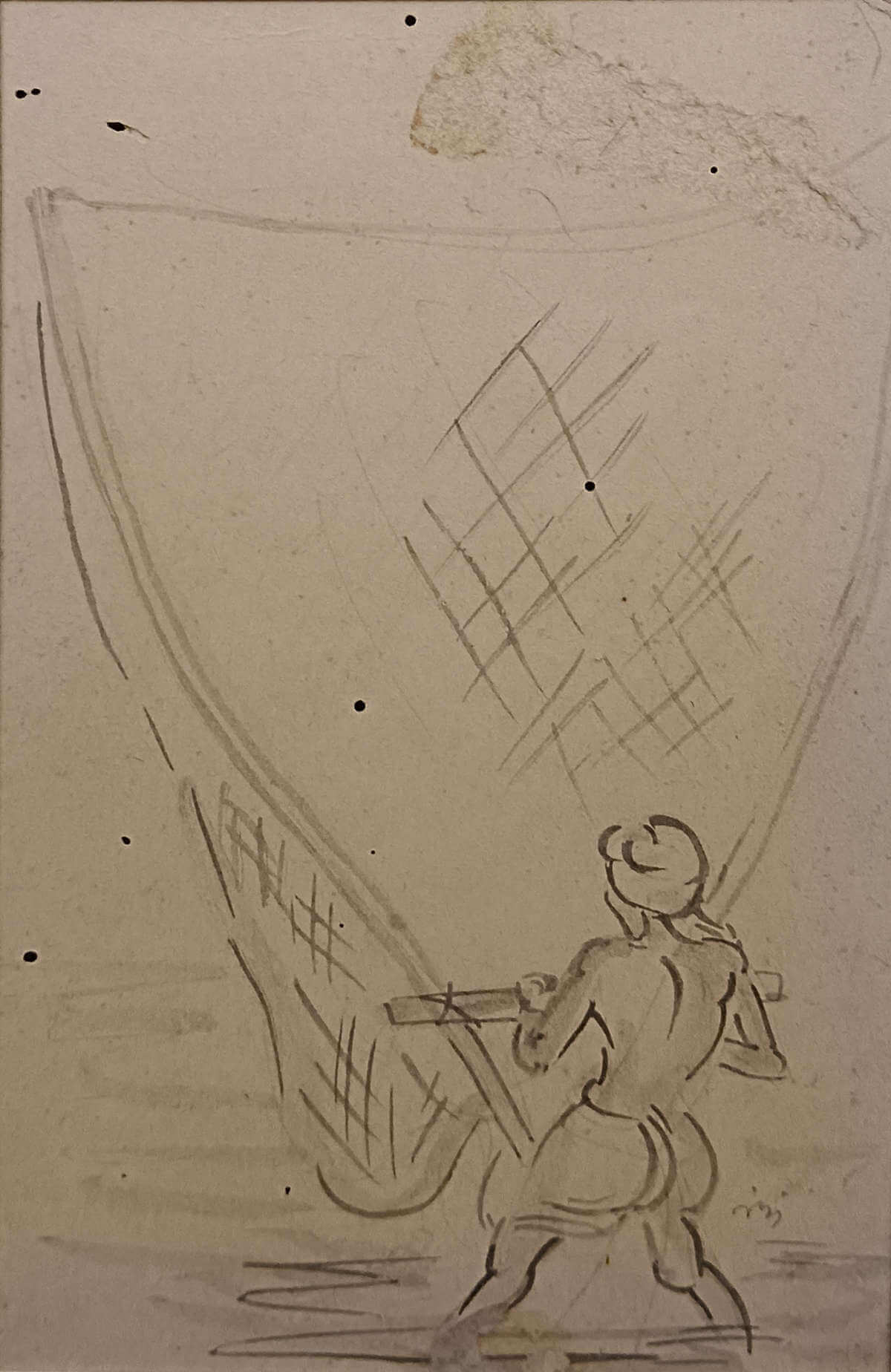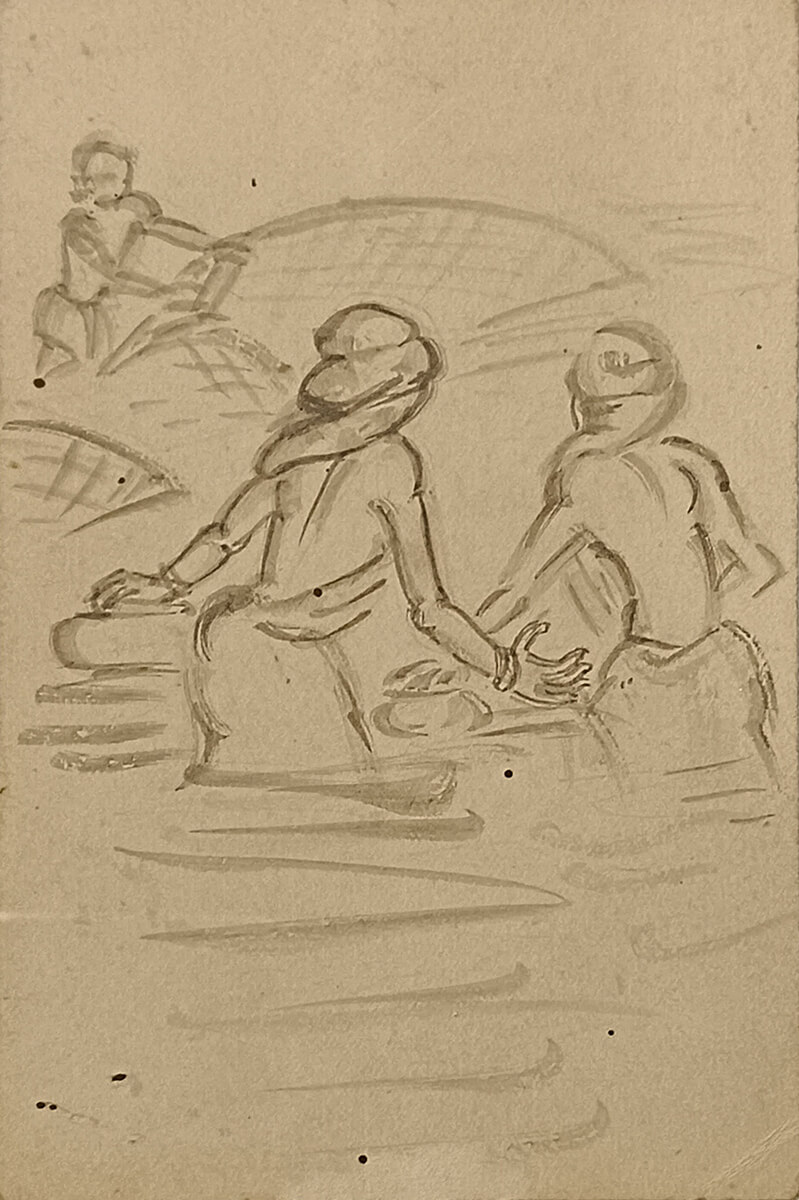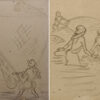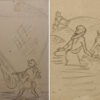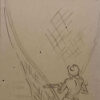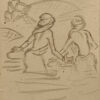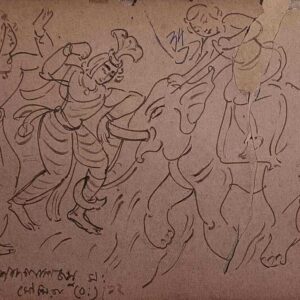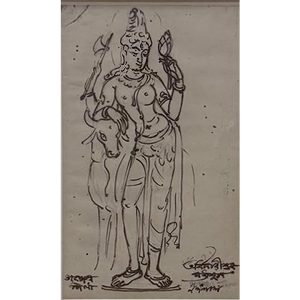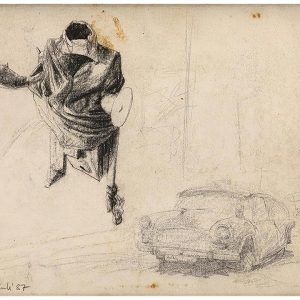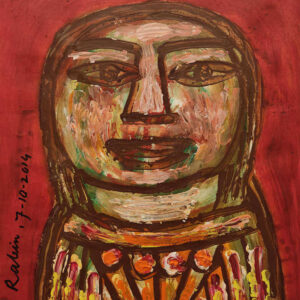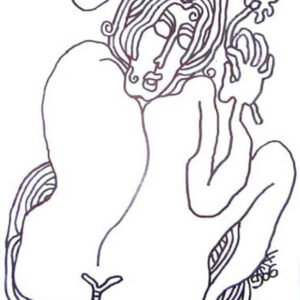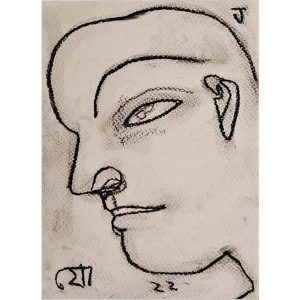
Nandalal Bose | Untitled | Drawing on Paper | 5.5 x 3.5 inches (Recto Verso) (Non Exportable)
This sensitive pencil sketch captures a moment of quiet physical effort, depicting a lone figure engaged in manual labour within a sparse, suggestive setting. Rendered with light, economical lines, the composition focuses on gesture and movement rather than detailed form. The bent posture of the figure and the angled tool convey strain and purposeful action, while the loosely indicated architectural or spatial elements around him provide context without overwhelming the scene. Subtle cross-hatching and soft tonal shifts add depth and rhythm, allowing the drawing to breathe with immediacy and restraint. The simplicity of the sketch underscores a deep empathy for everyday labour, transforming an ordinary act into a study of dignity, resilience, and human presence.
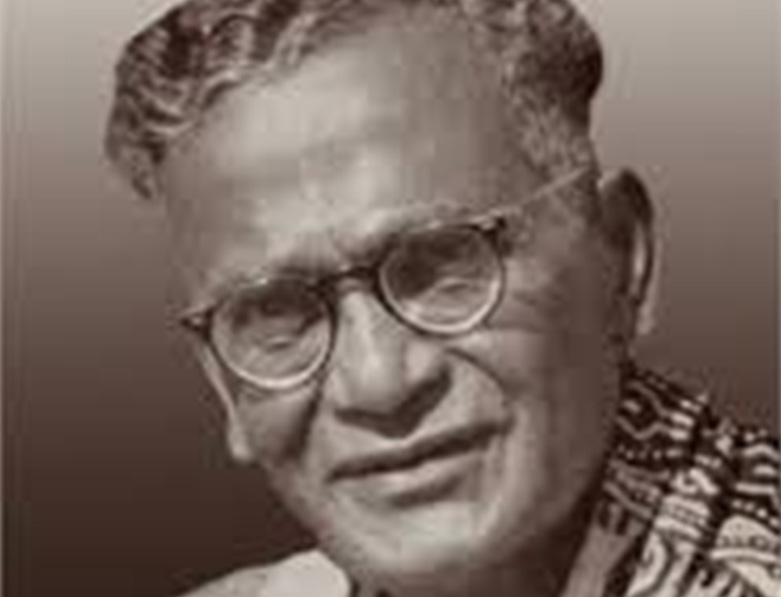 Nandalal Bose drew his early philosophical inspiration from ananda coomaraswamy, sister nivedita and E. B. Havell, and also from the japanese painters in calcutta whose influence impressed upon him the significance of valuing one’s artistic heritage.
Hailing from Munger in Bihar, he was fifteen when he came to Calcutta to continue his education, where his passion for art ultimately took him to the Government College of Arts and Crafts, to be groomed by Abanindranath Tagore from 1905-10.Close association with the Tagores awakened his idealism for a nationalistic consciousness and commitment toward classical and folk art, along with its underlying spirituality and symbolism.
When, in 1919, Bose was invited by Rabindranath Tagore to take charge of the newly-founded Kala Bhavana at his Visva-Bharati University in Santiniketan, he focussed mostly on the awakening of the creative potential of each student while laying emphasis on the unity of art and nature. In his own work, Bose experimented with the flat treatment of Mughal and Rajasthani traditions and played with the Sino-Japanese style and technique in his washes.
The 1930s saw a transition in his works from figuration to landscape. Engaging with various styles, Bose came up with a series of temperas marked by the impact of post-impressionist and expressionist renderings. His ‘posters’ for meetings of the Indian National Congress, and his illustrations, along with a group of other artists, of the Constitution of India, acknowledged his contribution to the creation of a new art for India.
Awarded the Padma Bhushan in 1954, his works were declared a National Art Treasure under the Antiquities and Art Treasure Act 1972. Bose passed away in Calcutta on 16 April 1966.

If you’d prefer the artwork to arrive ready to hang, please get in touch with us to arrange framing and shipping at applicable charges.
Please note: Customs duties and import taxes may apply at your destination in accordance with your country’s regulations. Refer to our International Shipment document for guidance and support.
| Medium | |
|---|---|
| Surface | |
| Height | |
| Width | |
| Style |