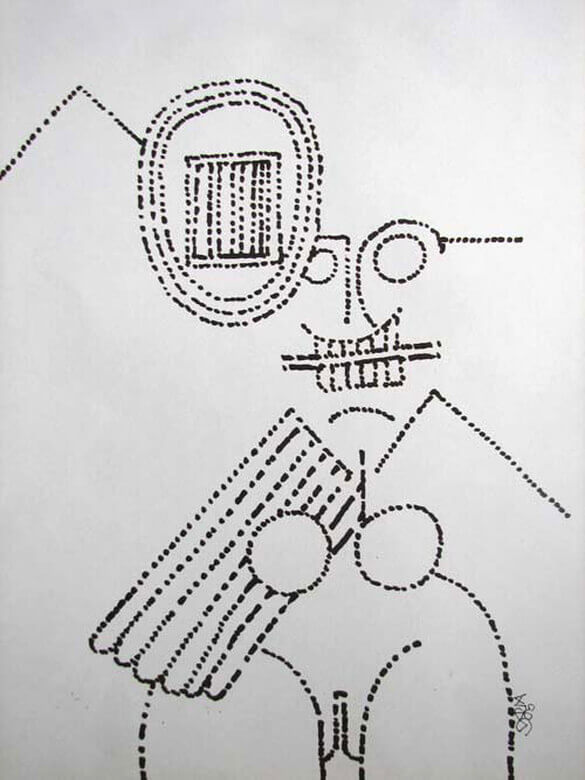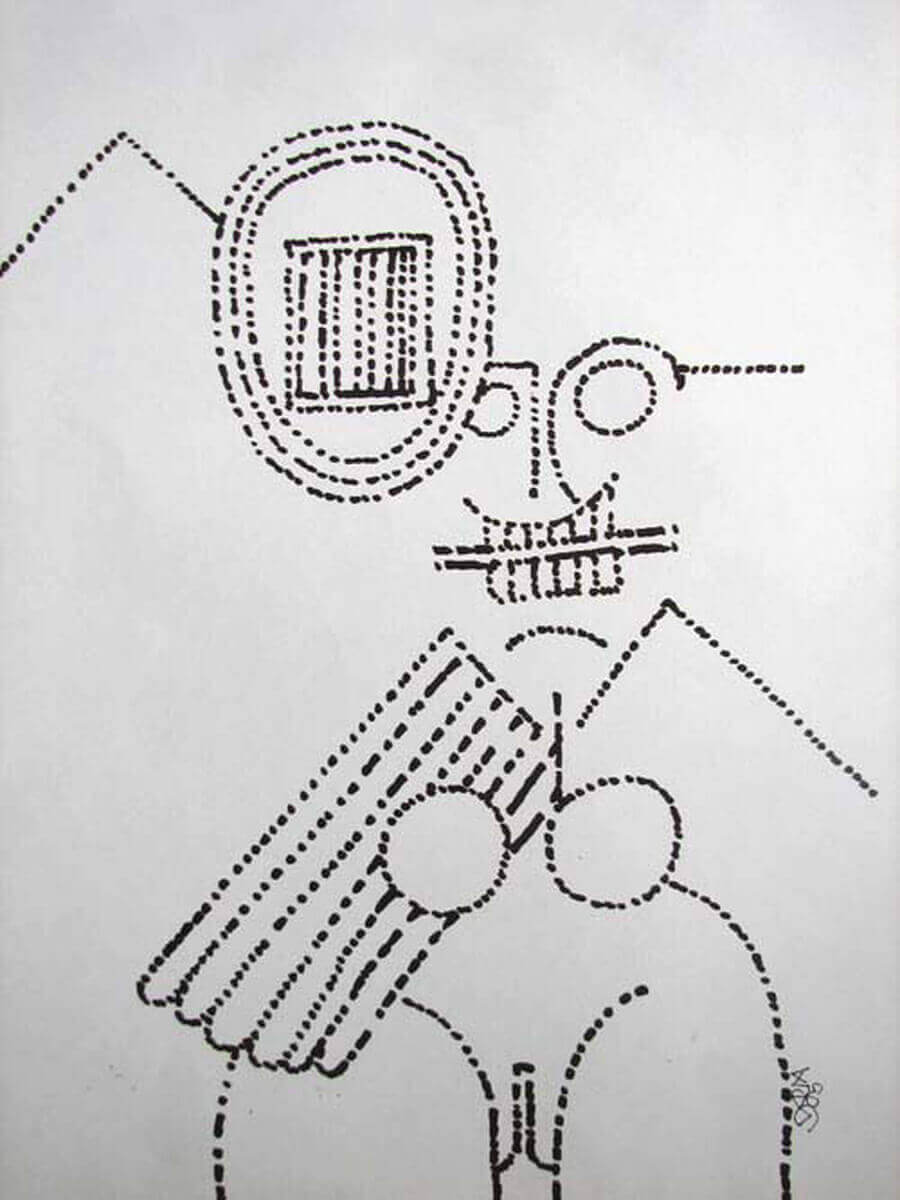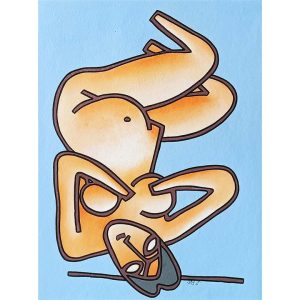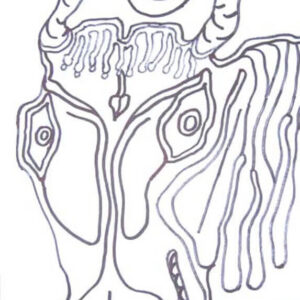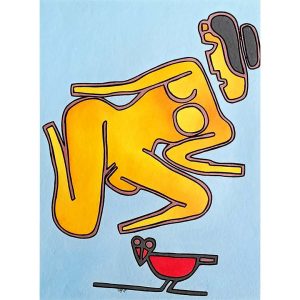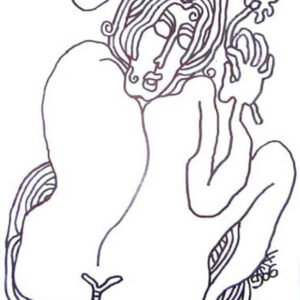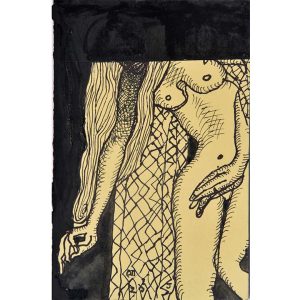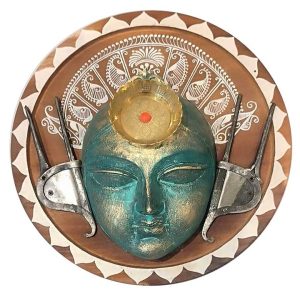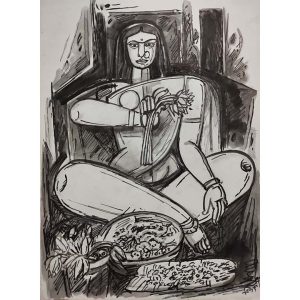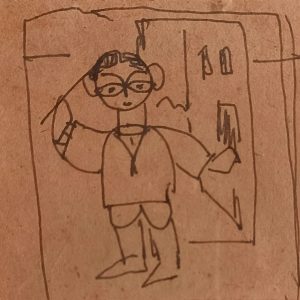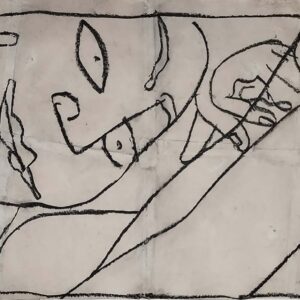
Prokash Karmakar | Untitled | Ink on Paper | 14.5 x 10.5 inches | 2006
This untitled ink-on-paper work by Prokash Karmakar (2006) is a striking example of how simplicity can carry profound character. Created entirely through rhythmic dotted lines, the composition reveals a stylized human figure that feels both playful and enigmatic. The artist abandons solid contours, instead building the form through carefully placed marks — each dot contributing to a larger visual pulse.
The face, almost mask-like in structure, carries a quiet intensity. Geometric elements — circular eyes, striped patterns, and angular outlines — interact harmoniously, creating a balance between abstraction and figuration. The dotted technique lends the artwork a tactile quality, as if the image is slowly emerging from silence. It invites the viewer to look closer, to trace each mark, and to discover personality within minimalism.
This 2006 piece reflects Karmakar’s experimental spirit and his ability to distill human presence into essential forms. Ideal for collectors who appreciate modern Indian drawings and works that combine wit, structure, and subtle emotional resonance.
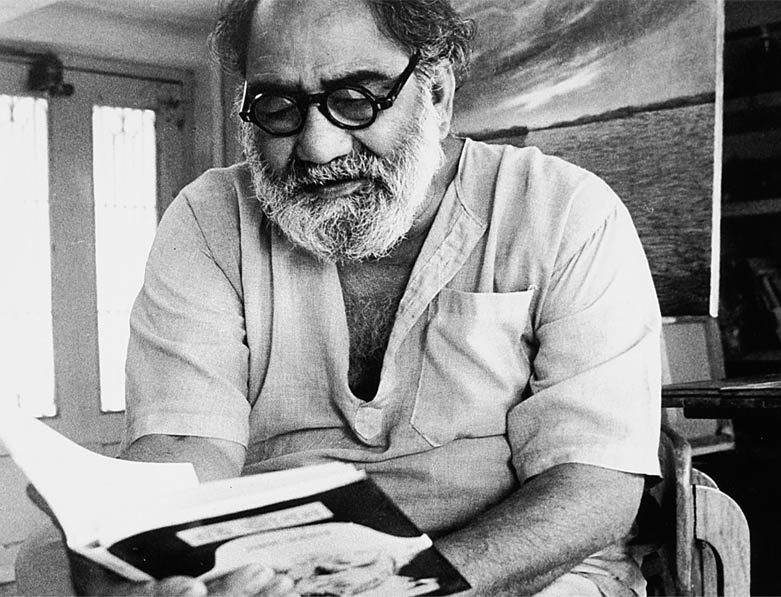 Prokash Karmakar’s art emerged from a contemplation of life, through the prism of personal traumatic experiences intermingled with dark moments in india’s recent history.
He learnt painting at his father, artist-teacher Prahlad Karmakar’s atelier, till the socio-political turmoil of the 1940s and his father’s early death put an end to it.
After his matriculation, Karmakar joined Government College of Arts and Crafts, Calcutta, but quit soon thereafter for reasons of poverty. In between, he designed book covers and worked as an illustrator for his livelihood; he even joined the army but absconded after two years, driven by his desire to paint.
Karmakar learnt the techniques of transparent and opaque watercolours from Kamalaranjan Thakur, a former student of his father, and Dilip Das Gupta. However, it was senior artist Nirode Majumdar—once a student of Abanindranath Tagore—who acquainted Karmakar with artistic and philosophical concepts, techniques, coherence of lines, and the breaking of form. Majumdar had recently returned from France after a stay of twelve years, and shared his rich experience with his protégé.
Karmakar held his first exhibition in 1959 on the railings of Indian Museum, Calcutta. In 1969-70, Karmakar visited France on a fellowship to study art museums, an inspiring exposure for the expressionist artist who, being ‘primarily a colourist’, began to create his figurative monochrome paintings in the 1970s. He won the Lalit Kala Akademi’s national award in 1968, and his work is part of important collections globally.
He passed away on 24 February 2014.

If you’d prefer the artwork to arrive ready to hang, please get in touch with us to arrange framing and shipping at applicable charges.
Please note: Customs duties and import taxes may apply at your destination in accordance with your country’s regulations. Refer to our International Shipment document for guidance and support.
| Medium | |
|---|---|
| Height | |
| Width | |
| Surface | |
| Style |