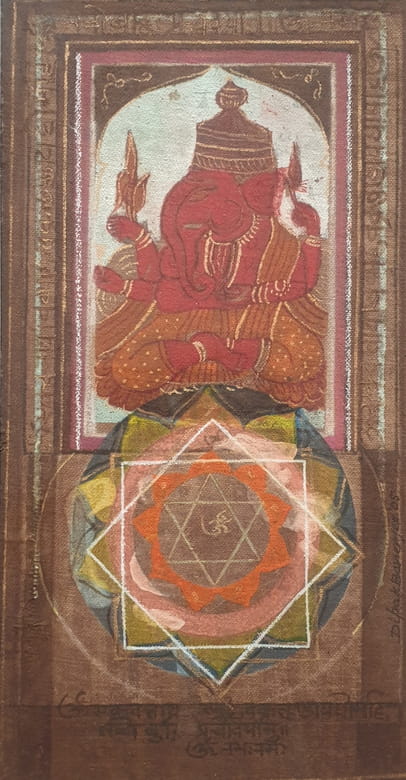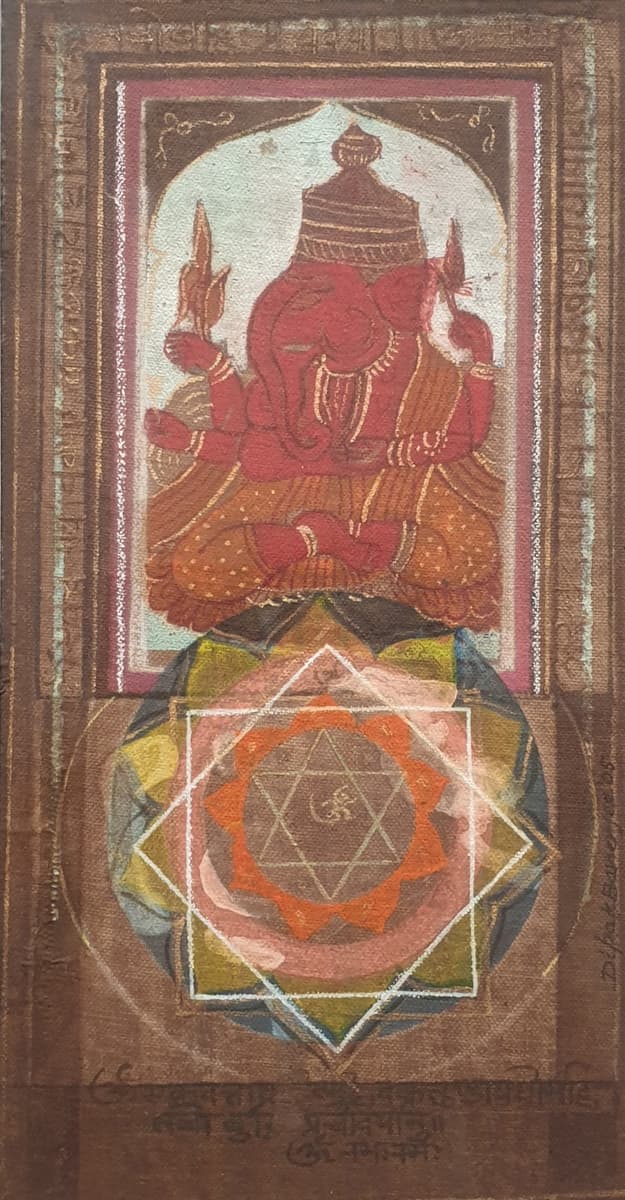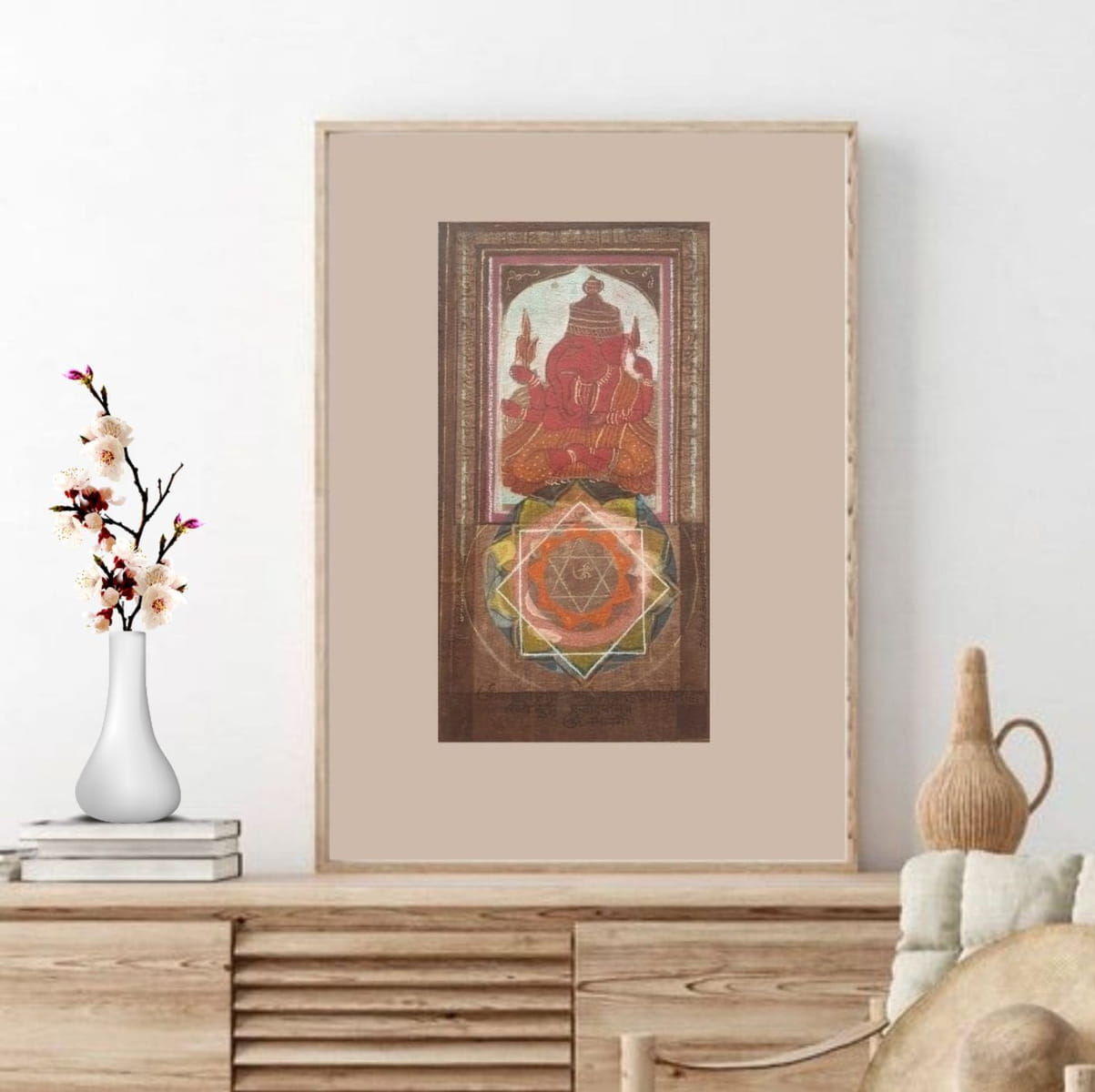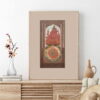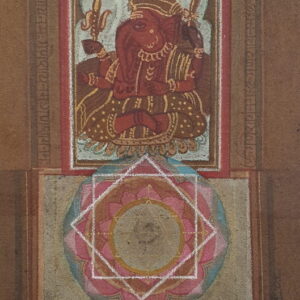
Dipak Banerjee | Ganesha | Mixed Media on Canvas | 11 x 8 inches
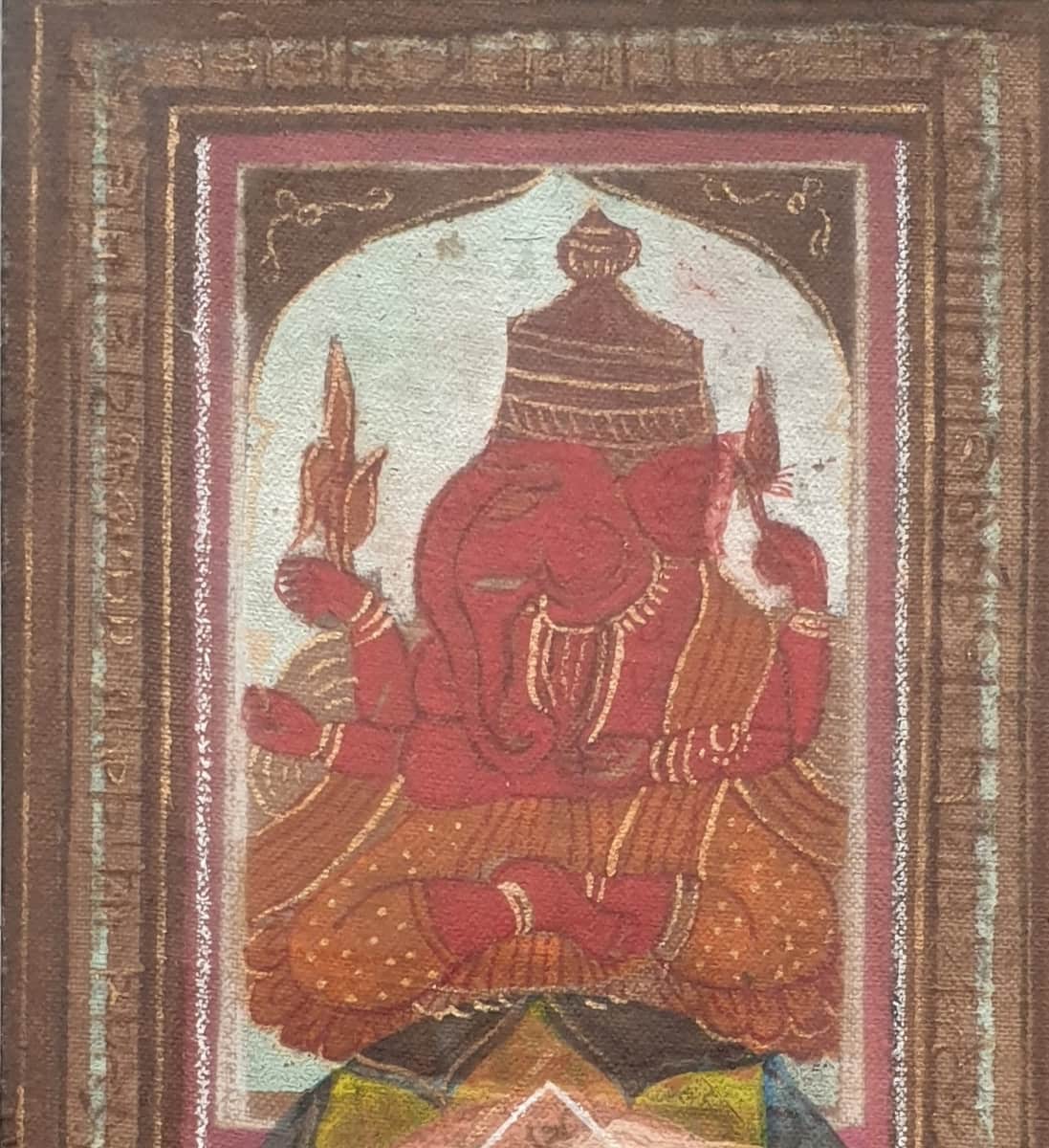
This spiritually evocative artwork presents a powerful depiction of Lord Ganesha, blending sacred symbolism with a deeply meditative visual language. Rendered in warm earthy tones of crimson, rust, ochre, and muted gold, the composition carries the essence of devotion, balance, and inner awakening. The seated form of Ganesha appears calm yet commanding, framed within an architectural arch that resembles the sanctity of a temple shrine, inviting the viewer into a space of reflection and spiritual stillness.
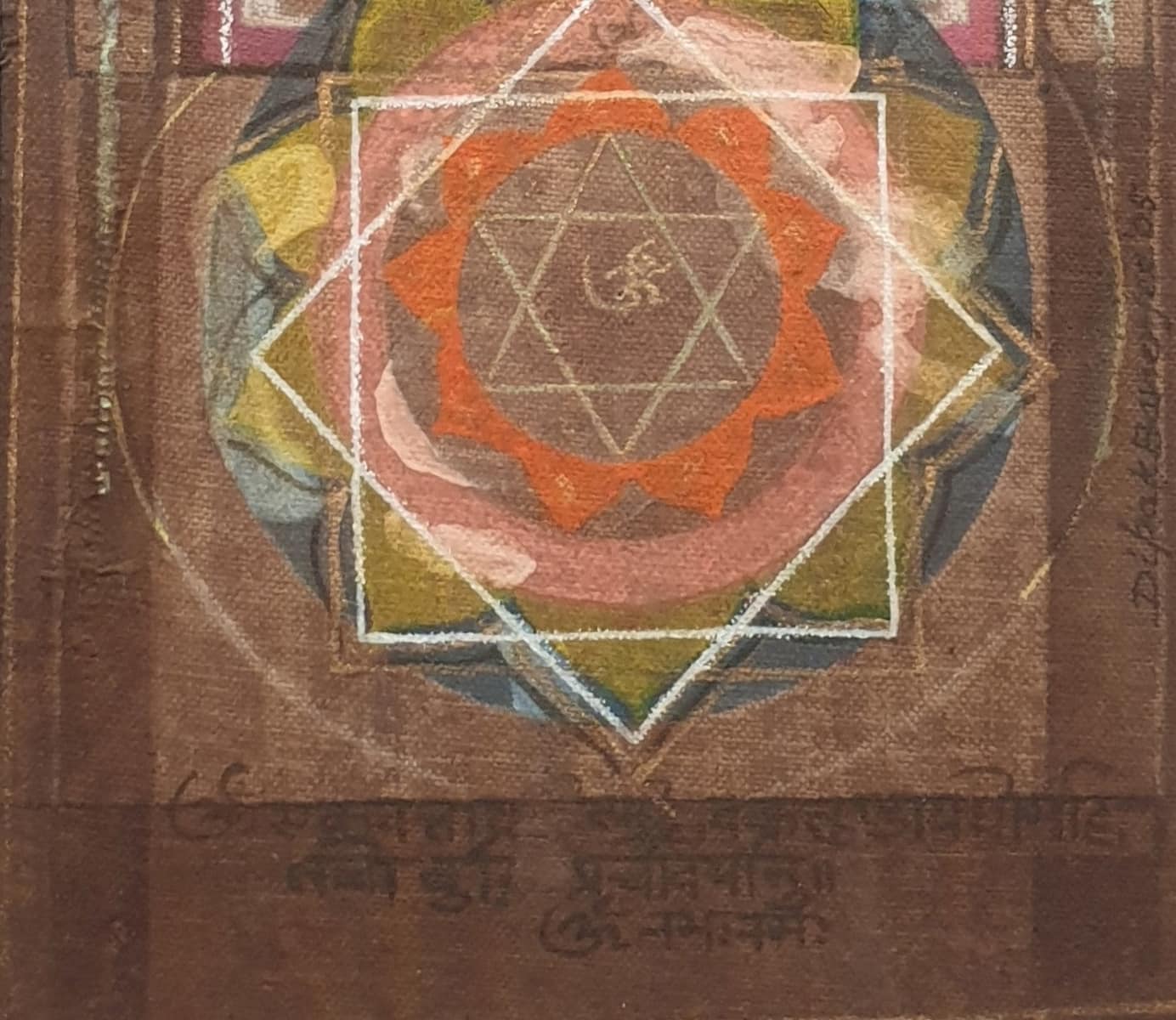
What makes the work especially captivating is the integration of geometric yantra-like patterns beneath the deity. These sacred forms symbolize cosmic harmony, divine energy, and spiritual alignment, creating a beautiful dialogue between form and philosophy. The layered textures and hand-worked surface give the painting an aged, timeless quality, almost like an artifact preserved through generations of faith and ritual.
The artwork carries an intimate and contemplative energy rather than overt grandeur. It speaks softly of wisdom, protection, prosperity, and the removal of obstacles — the eternal attributes associated with Ganesha. Ideal for collectors who appreciate spiritual art with depth and symbolism, this piece creates a serene presence in any living space, meditation corner, or curated art collection.
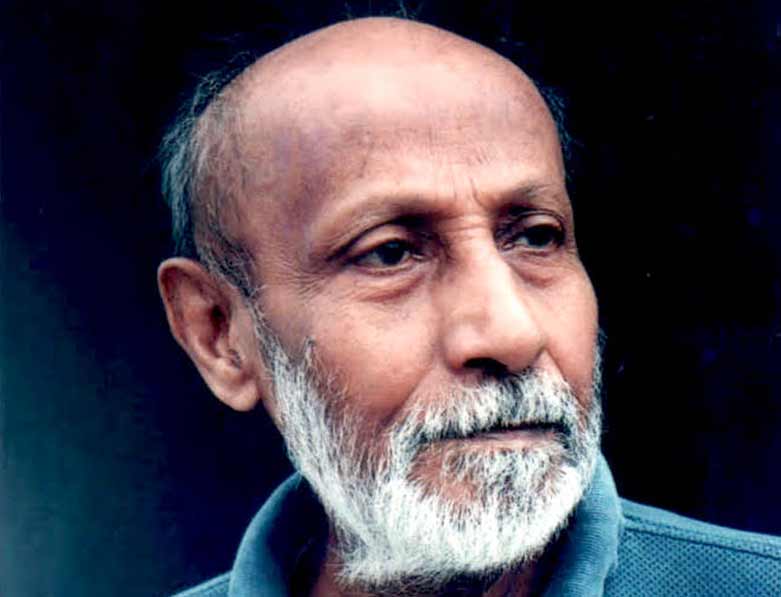
In 1946, Dipak came to Kolkata. Next year, the riot spread like wild fire throughout Bengal. Same year, India got independence through the partition of Bengal. Dipak, then only 11, could not realize the intensity of the situation, its adverse effects. Henceforth, this political crisis peeped nowhere as backdrop in his canvas. Dipak grew up in an artistic environment. His elder brother, lover and patron of art, collected many artifacts which gave a boost to Dipak to enhance his artistic brilliance. Music, too, was his forte. He learnt Rabindra-Sangeet and attended many classical music conferences. His indomitable passion made him portray various landscapes, portraits etc.
Later he joined Govt. College of Art and Craft, Calcutta for a professional exposure. Ramendranath Chakraborty, an eminent artist in the field of graphics, was then the principal of the college. During the first and second years in art college, due importance was given to black board drawing and sketches. Along with his seniors like Arun Bose, Sanat Kar, Bijon Chowdhury, Dipak used to visit many market places, cow sheds etc for sketches. In the second year of elementary class, Dipak took Graphics as elective subject where he learnt wood-cut, Linocut etc., and various other methods of print making. Haren Das, a distinguished graphic artist, was his guide. Dipak did his specialization in painting but the graphic images of his elementary class were ingrained forever. Dipak received a certificate from Lalit Kala for a still life presentation. In course of time, the chapter of Art College was over. He prioritized seeking a job which initiated a new journey. While in Art College, Dipak’s work was mainly academic. Later, this streamlined to a different genre.
Every artist goes through some significant changes in life. It is in the sixties that Dipak got information from a friend that there would be recruitment of artists on daily basis at the Handicraft Board. His work was to collect different motifs. He used to copy the motifs engraved on the walls of temples. A significant phase of his life was spent in collecting motifs, transforming them to various designs while keeping intact the quality. The ‘Indian-ness’ of these visuals influenced his creation which is still fresh. In the year 1965, Dipak got a French Govt. Scholarship. He also got a opportunity to work at Ecole Des Beaux Arts and Atelier 17. Dipak took interest in print making at Atelier 17. He learnt this print making from S W Hayter, a world renowned graphic artist and Krishna Reddy, as his teacher. This knowledge enriched him to expand both geographically and intellectually.
In 1967, he came back to Delhi from Paris. He held some magnificent show of graphic prints Excellence he achieved was evident in almost all his works. Ultimately, he joined Benaras Hindu University as lecturer in the department of print making. The symbolic concepts which were chosen as theme of his paintings brought out the religious fervor deeply embedded in hs thoughts. Temples, lanes, by-lanes, bathing ghats of Benaras which he sketched in Paris now revealed a sublime touch. Though not a Tantric himself, Dipak gradually moved on to tantric mode of self realization. Tantra is a special manifestation of Indian philosophy. Dipak picked up Tantric symbolic motifs ‘Purusa’, ‘Prakriti’, ‘Vishnu’, ‘Kundalini’ with their geometrical patterns and thematic designs which represented the spiritual content in art. Lord Vishnu, as the universal creator was painted was painted in the form of a pair of foot as ‘Vishnupada’.
Dipak Banerjee’s paintings are a meditative blend of geometric abstraction and spiritual symbolism, reflecting his deep engagement with Tantric philosophy. His canvases evoke cosmic balance through mandalas, yantras, and mythological motifs, rendered in earthy palettes and layered washes. Banerjee’s visual language bridges ancient Indian iconography with modernist clarity, creating compositions that feel both timeless and contemplative.
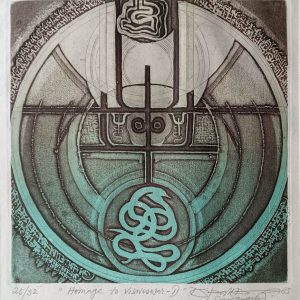
In his printmaking practice, Banerjee masterfully employs intaglio techniques, particularly etching and aquatint, to explore similar themes through a tactile, restrained medium. Trained at Atelier 17 in Paris, his prints exhibit precision, tonal subtlety, and textural depth. These works distill spiritual concepts into intricate surfaces, marrying technical finesse with metaphysical inquiry.
Dipak Banerjee can be said to be within the lineage of artists like Biren De and G.R. Santosh, while noting Banerjee’s unique ability to transcend ritualistic Tantra and offer a more universal spiritual aesthetic.

If you’d prefer the artwork to arrive ready to hang, please get in touch with us to arrange framing and shipping at applicable charges.
Please note: Customs duties and import taxes may apply at your destination in accordance with your country’s regulations. Refer to our International Shipment document for guidance and support.
| Medium | |
|---|---|
| Surface | |
| Width | |
| Style |